TECHNICAL GUIDE · OCR, LPR AND ALPR
Vehicle ALPR: automatic plate recognition without shortcuts

A legible plate in an image can become a structured record. Between capture and any decision lie field conditions, confidence criteria, integrations and responsibilities that must be defined.
OCR / LPR
On this page
Vehicle ALPR uses computer vision to locate the plate region in an image and recognize its characters. LPR, ALPR and ANPR refer to the same family of solutions, with vocabulary varying across markets and projects.
A reading alone does not prove vehicle identity, a violation or the validity of an administrative action. It produces data with context and measurable quality for a later workflow.
THE CONCEPT
A plate is a visual object before it becomes a character string
The system must find the plate, account for perspective and lighting, and then interpret what is visible.
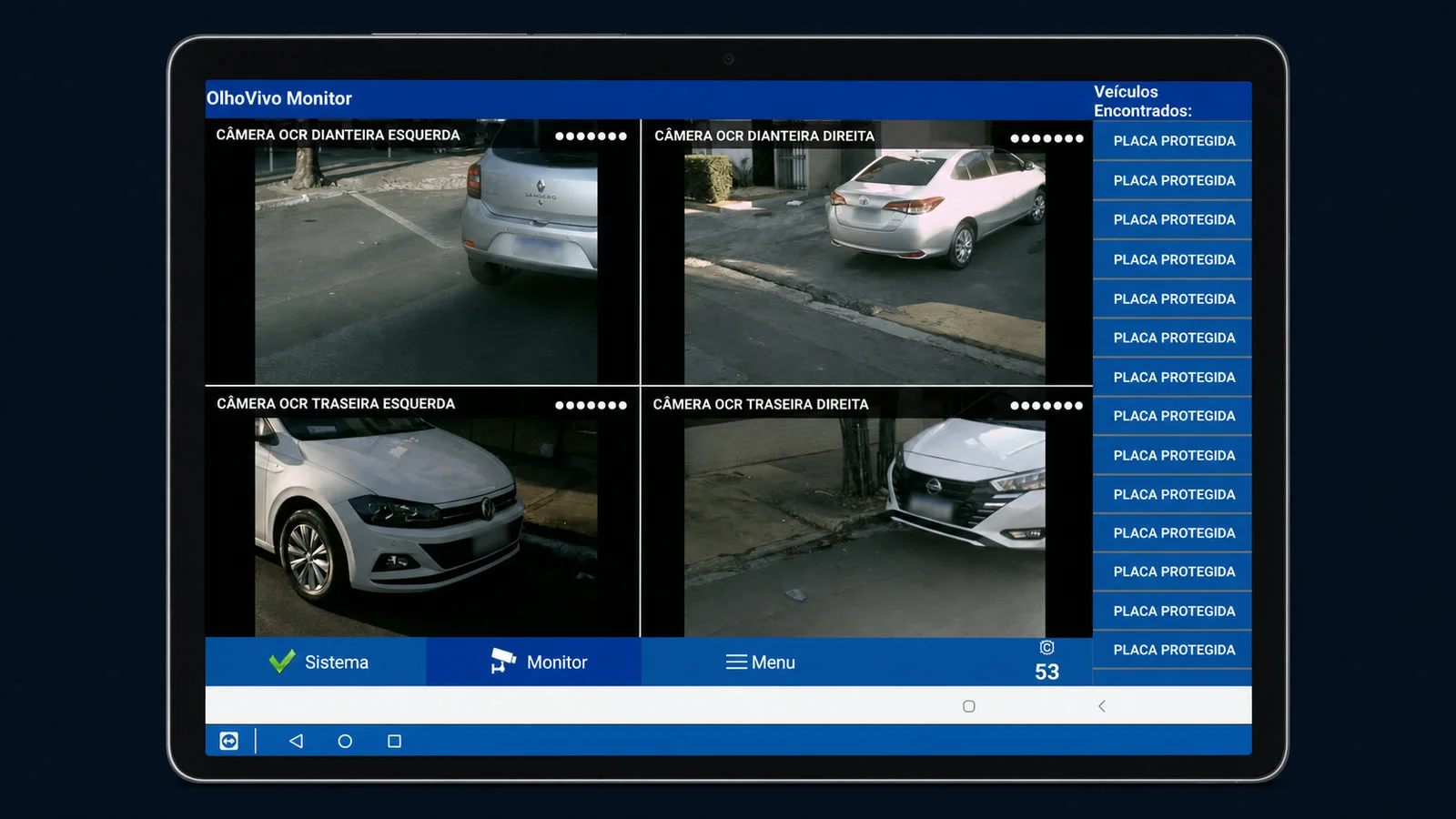
A camera records the scene. Processing searches for regions consistent with license plates, selects candidates and attempts to recognize their characters. A useful result also preserves data such as time, camera, frame and confidence, depending on the contracted configuration.
A query to an authorized database, when available, is a separate step. It should not be confused with visual recognition or used to conceal an inconclusive reading.
THE RESULT
Confidence guides review; it does not turn a hypothesis into certainty
An output may contain the recognized string and a confidence indicator. The threshold used to accept, review or reject a reading depends on purpose, risk and the project's acceptance test.
Partial occlusion, glare, dirt, motion, low light or an extreme angle may reduce the available information. In some cases, the technically correct response is to mark the event as inconclusive.
FROM DATA TO USE
The same reading can support different workflows under different rules
Parking management, access control, traffic studies and enforcement support begin with different objectives. Each use must define its purpose, permitted sources, retention, owners and treatment of exceptions.
This guide therefore separates the reading capability, the complete vehicle and the citation procedure. That division avoids implying that a camera alone completes the entire process.
- Reading event: visible plate, context and recognition quality.
- Query or rule: a later step tied to an authorized source and purpose.
- Decision: the responsibility of the competent system and authority for that use.
BEFORE PROCUREMENT
Responsible performance is performance measured for the intended operation
There is no universal percentage that describes every camera, route and plate. A sound assessment uses a representative sample, ground truth annotated before testing and metrics defined by condition.
- Separate plate detection, exact-string recognition and inconclusive results.
- Measure false positives and false negatives, not just easy cases.
- Record camera, position, speed, lighting, weather and plate condition.
- Validate latency, volume and offline behavior on the contracted architecture.
Vehicle OCR, with distinct search intents
Continue with the right topic
Each chapter answers a different question about automatic license plate recognition.
From explanation to operation
Explore related solutions
Direct answers
Frequently asked questions
Are OCR, LPR, ALPR and ANPR the same thing?
They belong to the same family. OCR describes character recognition; LPR, ALPR and ANPR emphasize automatic plate location and reading. The actual scope depends on the product and project, not the acronym.
Does an ALPR reading identify the vehicle owner?
No. The image can support recognition of visible characters. Any registry query is a separate step subject to an authorized source, a defined purpose and access controls.
What is vehicle ALPR accuracy?
There is no responsible universal percentage. Results vary with the camera, installation, speed, lighting, angle, occlusion and plate condition. Accuracy must be measured on a representative sample of the contracted operation.
Does a reading automatically issue a citation?
Not by itself. The reading is one input to a workflow. Classification, evidence, authority, preparation of the violation report and later acts follow the law and procedure established by the traffic authority.
Can processing continue without connectivity?
Local capture and processing can continue when the contracted architecture supports that mode. Remote queries and synchronization depend on connectivity and require tested queues, states and reconciliation.
Verifiable references
Sources consulted
- Lei nº 9.503/1997 — Código de Trânsito Brasileiro Presidência da República do Brasil
- Resolução CONTRAN nº 909, de 28 de março de 2022 Conselho Nacional de Trânsito
- Resolução CONTRAN nº 920, de 28 de março de 2022 Conselho Nacional de Trânsito
- Diferença entre videomonitoramento e SAnMFT Instituto Nacional de Metrologia, Qualidade e Tecnologia