Painting a dedicated lane on asphalt is the inexpensive part of any urban mobility policy. The hard part is preventing a single car parked "just for five minutes" with hazard lights flashing from turning an entire transit corridor into an improvised parking lot and forcing buses to weave into adjacent traffic.
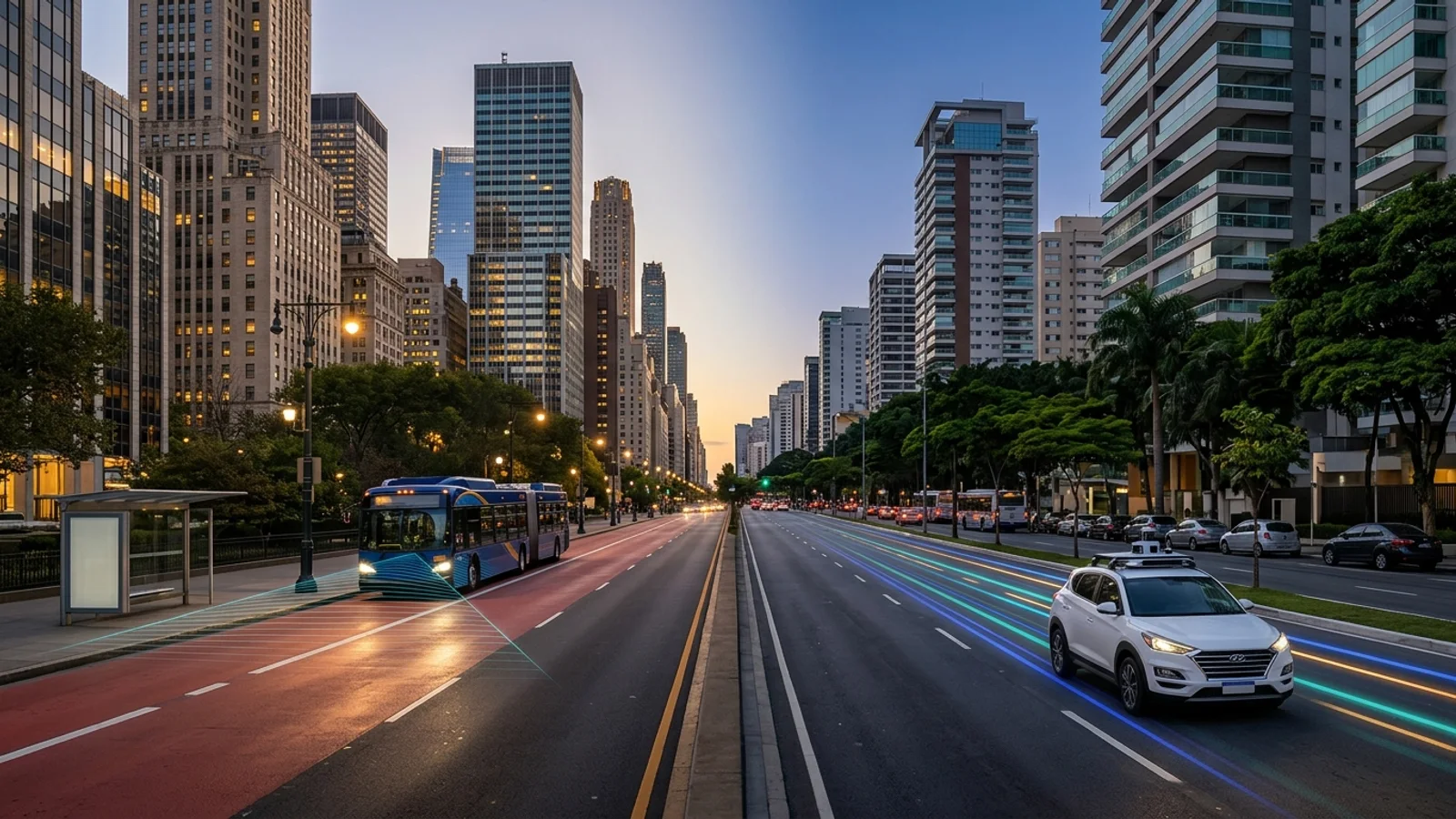
New York City chose to address that bottleneck where it happens: in motion, directly through the windshields of its transit fleet. Operated by the Metropolitan Transportation Authority (MTA) alongside the New York City Department of Transportation (NYCDOT) and Department of Finance (NYCDOF), the Automated Camera Enforcement (ACE) program surpassed 2,000 buses outfitted with onboard computer-vision cameras across 2025 and 2026. That covers roughly one-third of the city's bus fleet across 76 routes in all five boroughs, serving more than 1 million weekday riders.
Unlike smart-city pilots that end at a press conference without publishing street metrics, New York opened its operational numbers. Those results show why transit and parking agencies worldwide now treat connected vehicle fleets as active curb infrastructure.
What Changed on New York Streets Once Curb Obstructions Stopped Being Invisible
Evolving out of the earlier Automated Bus Lane Enforcement (ABLE) initiative, ACE expanded beyond dedicated bus lanes to capture two other chronic urban blockages: double-parking along bus corridors and vehicles standing in bus stops.
The rollout design avoids sudden enforcement traps. Whenever a new route goes live, motorists detected during the first 60 days receive mailed warning notices rather than fines. Once that warning window closes, video clips, license plate reads, timestamps, and coordinates captured by the bus are transmitted for review by NYCDOT staff before a Notice of Liability is issued, starting at US$ 50 for a first violation and scaling up to US$ 250 for repeat offenses within a 12-month window.
Performance metrics published by the MTA, tracked on the New York State Open Data portal, and highlighted internationally by UITP point to four measurable outcomes on active corridors:
- Faster transit without heavy civil works: bus speeds rose by roughly 5% on average across enforced routes and gained nearly 30% along the most congested segments.
- Accessible curbs: blocked bus stops dropped by roughly 40%, allowing buses to pull flush to the curb rather than forcing wheelchair users, seniors, and parents with strollers to board in active traffic lanes.
- Fewer crashes and lower emissions: active corridors recorded roughly a 20% drop in traffic collisions alongside an estimated 5% to 10% reduction in stop-and-go bus emissions.
- Rapid behavioral shift: roughly 90% of drivers who receive a violation never receive a second one.
That last figure matters for every municipal administrator. Clearing the curb did not require fining the same drivers month after month; making detection consistent was enough to prompt nine out of ten motorists to change behavior after a single notice.
The Unseen Engineering Behind a Windshield Camera
Looking at a compact camera housing behind a Manhattan bus windshield makes large-scale mobile monitoring appear simple. Mounting optics is the easy step. Three engineering hurdles separate a small pilot from a daily metropolitan operation:
- Edge triage inside the vehicle: streaming raw high-definition video continuously from hundreds or thousands of moving vehicles overwhelms mobile carrier links. Computer vision and plate recognition must run locally on onboard hardware, filtering relevant operational events from ordinary street traffic before transmission.
- Trusted positioning inside urban canyons: avenues lined with skyscrapers bounce satellite signals off glass and concrete facades. Distinguishing a legally parked car near a corner from one standing inside a restricted zone demands verified location coherence alongside visual capture of curbside regulatory signage.
- Continuity across unstable mobile networks: no fleet covers dozens of kilometers a day under uniform cellular bars. Tunnels, building shadow zones, rapid 4G and 5G tower handovers, and congested cells interrupt connections mid-route. Without resilient transport and state reconciliation, field records stall, arrive out of sequence, or get lost during uncoordinated retries.
How This Architecture Already Runs in Brazilian Cities (and How Legal Rules Differ)
Connecting New York's results to Brazilian cities starts with an explicit legal boundary: regulatory frameworks cannot be copied verbatim across jurisdictions. New York operates under specific state authorization for civil owner-liability notices on transit corridors. In Brazil, traffic enforcement is governed by the Brazilian Traffic Code (Article 280) and CONTRAN regulations, including Resolutions 909/2022 and 920/2022 according to system category and operational scope. In Brazilian cities, an onboard OCR reading or computer-vision event never generates an automatic citation on its own: technology captures, structures, and preserves context so authorized traffic officers and the competent public authority can review and act under due legal procedure.
Within that legal framework, Brazilian municipalities do not need imported platforms to run metropolitan-scale mobile monitoring. That engineering already operates daily across the country through technology developed by Areatec in Araras, São Paulo, supporting an institutional footprint of 317,000 managed parking spaces, more than 600 million transactions processed per year, and more than 307.7 million OCR license plate reads processed per year.
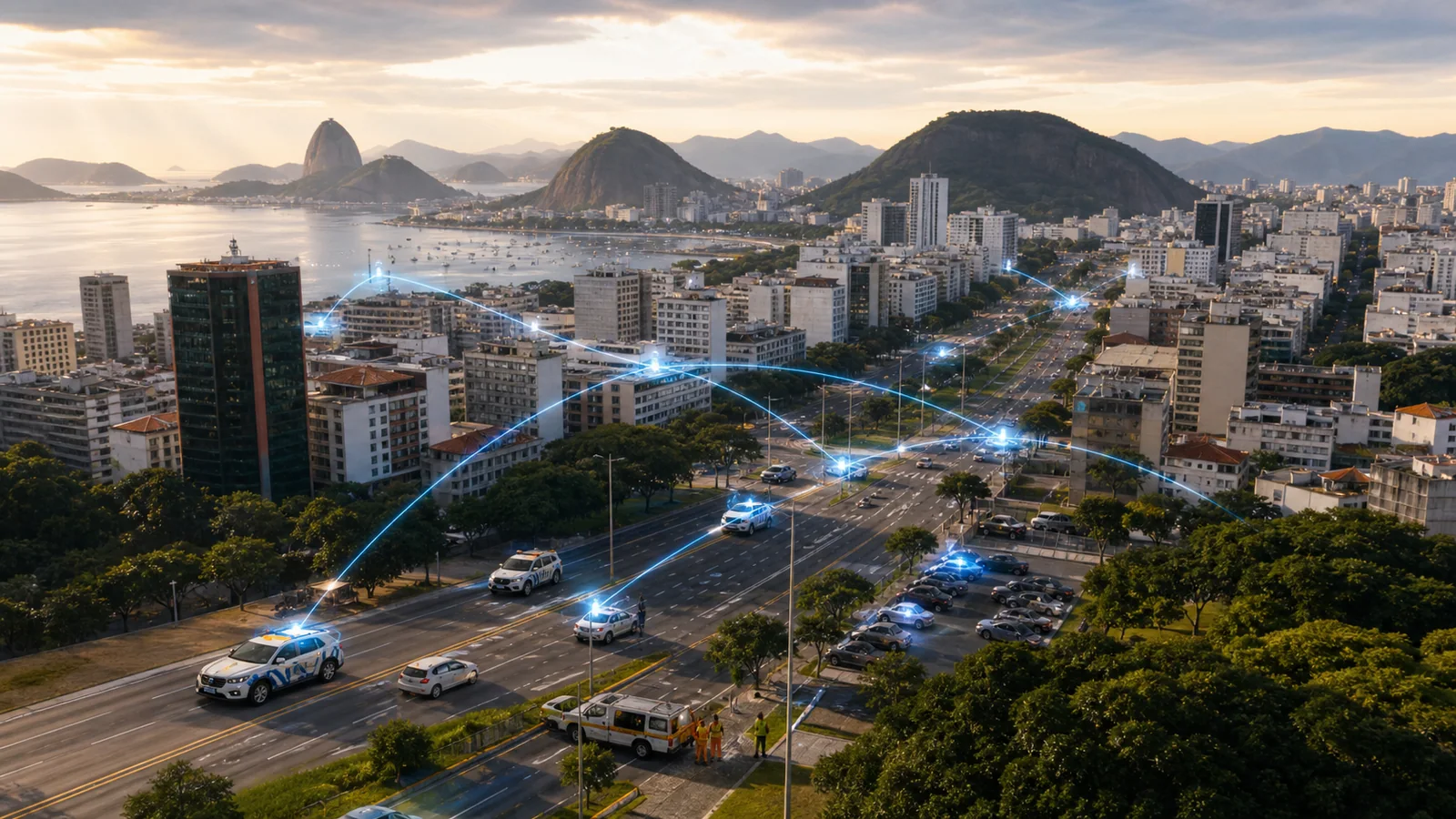
On the street, Olho Vivo Patrol operates across an aggregate base of roughly 150 vehicles. In São Paulo's regulated parking operation alone, around 100 OCR vehicles form the largest Olho Vivo Patrol fleet in the world, covering hundreds of kilometers every day across 52,783 regulated Zona Azul spaces registered by CET/SP. While the driver focuses strictly on driving safely, onboard cameras and Aretron edge processing read license plates, interpret visual vehicle attributes, and map R-6b regulatory parking signs along covered routes, delivering structured events to Olho Vivo City for real-time review by CET/SP officers.
When municipal contracts include broader street-management workflows, the same pass that supports regulated street parking can feed Smart Signage inventories and Urban Maintenance triage, while Smart Blur applies selective visual protection to bystanders' faces. To handle dense urban canyons, Pintrust cross-checks independent positioning signals at capture time and binds a position certificate to the file, while AreaChain preserves digital fingerprints and event sequences for later audit verification.
Underneath every route run the two communication layers we recently examined alongside Voyager 1's one-light-day milestone: DataRace and SyncRealTime. Whenever an OCR vehicle or an officer carrying the Electronic Ticket handheld crosses cellular dead zones or rapid tower handovers, DataRace preserves a prioritized local queue and dynamically switches and manages transmission across TCP and UDP according to live link quality, using brief coverage bursts without stalling route capture or triggering reconnection storms. SyncRealTime then reconciles explicit state across vehicles, handhelds, and central platforms (tracking every item as pending, sent, confirmed, or reconciled) so control rooms never act on stale field counts.
Practical Takeaways for Municipal Leaders
New York's MTA deployment challenges two recurring assumptions in urban transport debates. First, speeding up surface transit and restoring curb turnover does not always wait on multi-year infrastructure construction. Second, mobile monitoring is not a perpetual fine machine; a 90% non-recidivism rate proves its main outcome is returning public curb space to its intended use.
For Brazilian city halls and concessionaires, the technical path is proven: establish a clear baseline on critical corridors (travel times, curb occupancy, and rule compliance), pair onboard edge capture and resilient connectivity with officer validation under Brazilian traffic law, and measure before-and-after outcomes transparently. To evaluate how this architecture fits your city's corridors, explore Areatec's documented public cases or speak with our technical team.
Sources and References
- MTA (Metropolitan Transportation Authority): Automated Camera Enforcement (ACE) Program
- City of New York (Department of Finance): MTA Bus Camera Violations
- State of New York Open Data: MTA Bus Automated Camera Enforcement Violations Dataset
- UITP (International Association of Public Transport): Automated Camera Enforcement (ACE) Award Project
- Planalto: Brazilian Traffic Code (Law No. 9,503/1997, Art. 280)
Frequently Asked Questions
- What measurable results did New York achieve with AI-equipped buses under the ACE program?
- Across more than 2,000 equipped buses on 76 routes, the MTA reported average speed gains around 5% (reaching nearly 30% on heavily congested segments), roughly a 40% reduction in blocked bus stops, about 20% fewer collisions on active corridors, and roughly 90% of cited motorists never receiving a second violation.
- In Brazil, can an onboard OCR vehicle issue automatic traffic fines on its own?
- No. Legal regimes differ by country. Under Brazil's Traffic Code and applicable CONTRAN resolutions, onboard OCR and computer vision capture and organize imagery, coordinates, timestamps, and context, but never issue automatic citations by themselves; review and enforcement actions remain with the competent traffic authority and its authorized officers.
- How does Olho Vivo Patrol maintain continuous operation when mobile networks fluctuate on city streets?
- Aretron runs visual processing locally inside the vehicle, reducing reliance on uninterrupted bandwidth. For transmitting structured events to the control center, DataRace maintains ordered local queues and dynamically manages switching between TCP and UDP according to live carrier conditions, while SyncRealTime explicitly reconciles pending, sent, confirmed, and reconciled states between field units and central platforms.
Article by Fábio Eduardo Cressoni Batistella, CEO of Areatec, with editorial and technical support from Aretron.