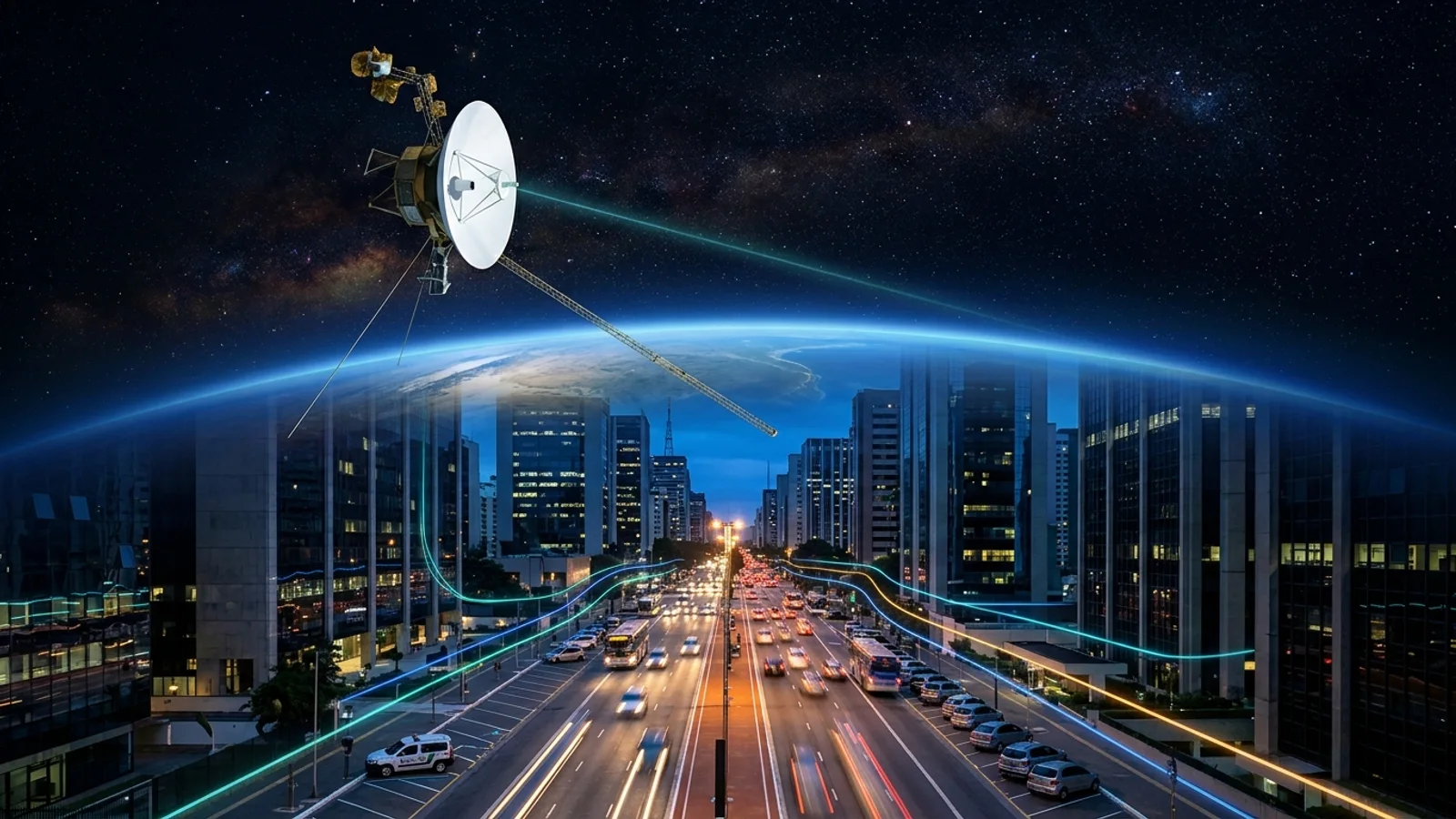
On November 18, 2026, nearly fifty years after lifting off from Cape Canaveral on September 5, 1977, NASA's Voyager 1 probe will become the first human-made object to reach a distance of one light-day from Earth. Traveling through interstellar space at roughly 61,000 km/h (38,000 mph), it will reach about 25.9 billion kilometers (16.1 billion miles) from our planet, more than 173 times the average distance between the Earth and the Sun.
The astronomical figure draws attention, yet its sharpest consequence shows up inside mission control. Radio waves cross a vacuum at the speed of light, close to 300,000 kilometers per second. At one light-day, any command transmitted from Earth takes 24 full hours to reach the spacecraft's 3.7-meter parabolic dish. Confirmation that the instruction arrived and executed takes another 24 hours on the return leg. Even the simplest exchange between an engineer and the machine requires two calendar days.
Keeping an operational system alive under that constraint dismantles a common assumption in modern software development: the belief that communication requires uninterrupted, instantaneous connectivity.
Talking to a Refrigerator Lightbulb 25.9 Billion Kilometers Away
The challenge goes well beyond waiting 48 hours for a reply. Physical signal attenuation dominates every engineering decision.
Voyager 1's radio transmitter runs on roughly 23 watts, comparable to the bulb inside a household refrigerator, powered by radioisotope thermoelectric generators that lose about 4 watts of electrical output per year. As the radio beam travels outward, its energy spreads across space. By the time it reaches the 70-meter dishes of NASA's Deep Space Network in California, Madrid, and Canberra, the received power drops to fractions of an attowatt (10-18 watt, one billionth of a billionth of a watt). Ground amplifiers must be cooled with liquid helium near absolute zero, around 4 Kelvin (-269 °C), so the thermal noise of terrestrial electronics does not drown out the spacecraft's pulse.
Over a link that thin, raw speed works against reliability. Instead of the megabits common on home broadband, Voyager 1 normally downlinks telemetry at 160 bits per second. Lowering the bit rate concentrates more energy into each bit so receivers on Earth can separate data from cosmic background noise. Frames also carry mathematical redundancy through forward error-correction codes (convolutional and Reed-Solomon), allowing ground systems to reconstruct bits corrupted by solar plasma and radiation without requesting a retransmission that would cost another two days.
Between November 2023 and April 2024, that architecture faced one of its hardest tests. A failed memory chip inside the Flight Data System (FDS) caused Voyager 1 to transmit months of unreadable binary patterns. Unable to replace hardware, engineers at the Jet Propulsion Laboratory split the affected code into smaller sections and relocated them across tiny unused pockets of 1970s memory. Months later, in October 2024, an automated fault-protection routine shut down the primary X-band transmitter and switched the probe onto a secondary S-band transmitter unused since 1981.
The spacecraft recovered from both incidents for the same reason it has operated since 1977: its design never assumed a clean, continuous, zero-latency link. It preserves local state, numbers and validates frames, uses narrow antenna windows without locking the channel into chatty back-and-forth dialogs, and never mistakes sending a command for confirming a state change on the other end.
From Interstellar Space to a Street Corner With No Bars
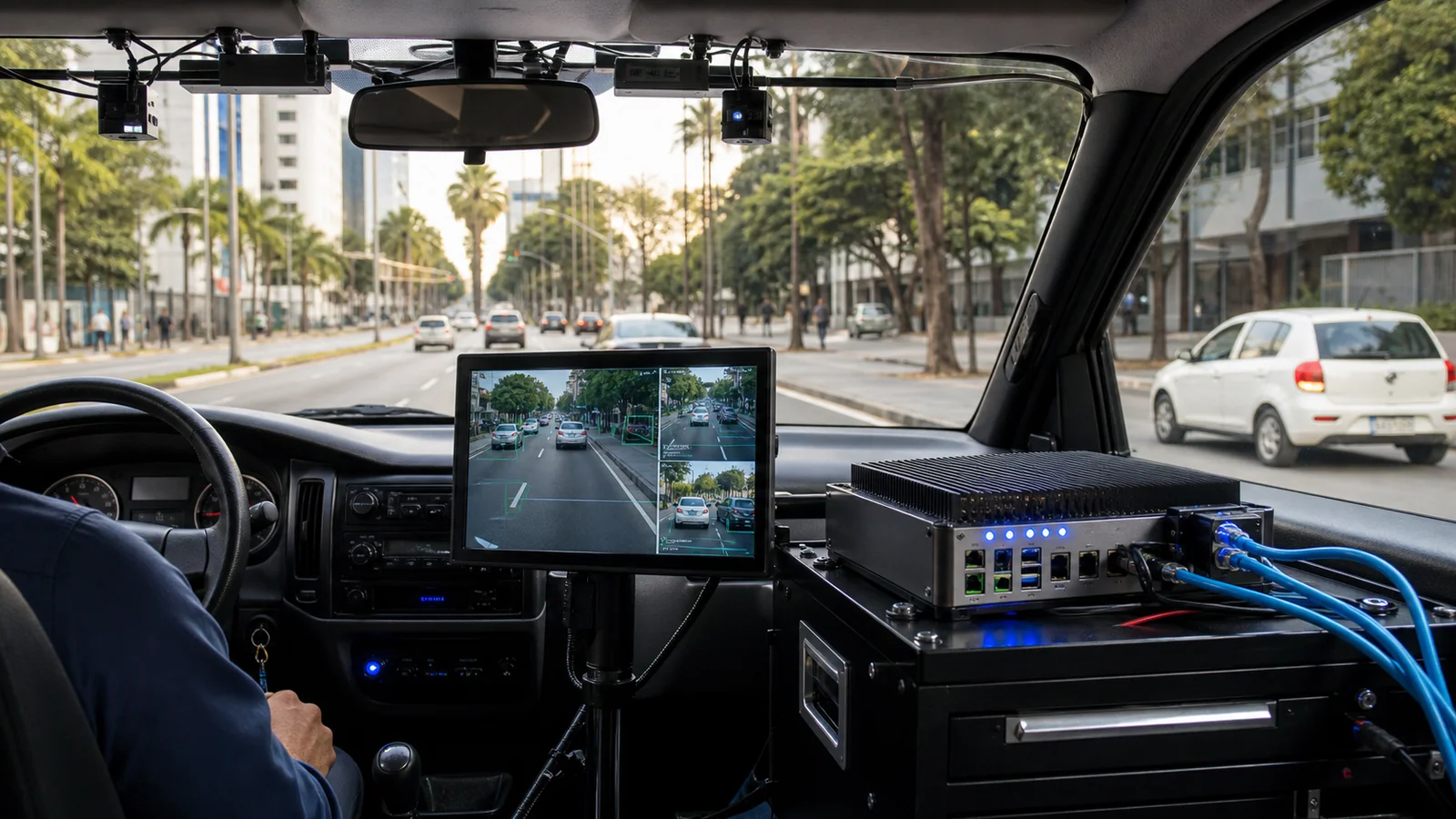
An urban monitoring vehicle or a traffic officer's handheld unit is not crossing interstellar space, yet neither operates inside a climate-controlled data center.
Much of the software procured by municipalities is built on a quiet office assumption: cellular coverage will hold steady, responses will arrive in milliseconds, and calling a remote endpoint will settle the record immediately. Street operations break that assumption every day. High-rise corridors block and reflect mobile signals, 4G and 5G tower handovers interrupt sessions in motion, heavy rain degrades radio links, dead zones appear along peripheral roads or highways, and major public events saturate carrier cells right when parking and traffic operations face peak demand.
When an urban platform treats packet loss as an edge case, municipal operations run into three familiar failures:
- Field stalls: the app or device freezes the officer's screen while waiting for an immediate reply the carrier cannot deliver at that moment.
- Reconnection chaos: operators tap repeat actions or devices dump hundreds of queued requests at once when signal returns, producing out-of-order records, duplicate charges, or backend overload.
- False green screens: the status bar shows cellular signal, yet dozens of events sit incomplete on the device without operations knowing that field reality and management reports have drifted apart.
In Areatec's engineering, shaped across field operations since the 1990s and now supporting an ecosystem of 317,000 managed parking spaces, more than 600 million transactions processed per year, and more than 307.7 million OCR license plate reads processed per year, solving this problem meant separating two distinct responsibilities: transport continuity and state reconciliation.
DataRace: Switching and Managing TCP and UDP When Links Degrade
On fixed office networks, nearly every application relies exclusively on TCP. The protocol completes a three-step handshake before carrying payload bytes, demands continuous acknowledgments, holds back subsequent packets whenever a single lost segment awaits in-order retransmission, and interprets radio loss as network congestion by throttling send rates. Opening a standard TCP connection to Voyager 1 at one light-day would burn 72 hours on the initial handshake alone before transferring a single byte, and one corrupted packet would stall the queue for another 48 hours. Constrained links cannot afford rigid conversational sessions when transmission windows are scarce.
City streets reproduce that bottleneck on a scale of seconds. While an Olho Vivo Patrol vehicle or an officer carrying the Electronic Ticket handheld operates under clean 4G or 5G signal, TCP handles ordered session streams effectively. Once the vehicle enters a building shadow zone, crosses rapid cell handovers, or encounters heavy packet loss, relying strictly on TCP wastes fleeting seconds of signal renegotiating sessions, waiting out timers, and blocking the entire queue behind a single delayed segment.
One of DataRace's core capabilities addresses this exact threshold: dynamically switching and managing transmission across TCP and UDP according to live network conditions. When the link is stable, DataRace uses structured TCP sessions. When it detects link degradation, erratic latency, or brief coverage bursts near a cell sector, it shifts and orchestrates dispatch over UDP, pushing independent datagrams immediately without spending scarce airtime on repeated session handshakes or stalling subsequent packets behind an isolated drop.
In conventional software, switching to UDP usually means giving up delivery control. Inside DataRace, that control lives in Areatec's transport management layer: every captured record sits in a persistent local queue with sequence numbering, chronological order, and operational priority, while controlled retry rules pace new attempts so a fleet regaining coverage at once does not trigger a retry storm, requiring explicit destination confirmation before closing the cycle. DataRace uses UDP's low-overhead speed during unstable signal windows without dropping records or scrambling operational order.
The same physical honesty seen in space communications applies here: neither TCP nor UDP creates cellular coverage where no network is available at that instant. When coverage drops completely, DataRace keeps records intact at the edge, makes pending items visible, and resumes transmission in the appropriate mode once a viable window returns, measured against the acceptance criteria defined for each project.
SyncRealTime: Delivering a Packet Is Not Reconciling State
Across the Deep Space Network, finishing an uplink transmission does not end mission control's work; engineers still verify that the spacecraft received the sequence intact, applied the change without duplicating prior instructions, and returned matching telemetry. Urban operations follow the same boundary: transport ends right where synchronization begins.
SyncRealTime is Areatec's proprietary layer for orchestrating and reconciling state across field devices, mobile apps, and central platforms such as Olho Vivo Parking. It is not a radio protocol; it is the state discipline that verifies the operational identity of each authorized participant and tracks every item through explicit stages: pending, sent, confirmed, or reconciled.
That distinction prevents silent errors before a shift even starts. Seeing signal bars on a screen does not mean a unit is ready for duty. Before heading out, an officer needs credentials, assigned zones, local rules, and paired equipment aligned with the municipal backend; SyncRealTime consolidates those checks so an active-looking interface never hides an operational gap. Likewise, when a route reconnects after network fluctuations handled by DataRace over TCP or UDP, controlled resumption prevents duplicates and preserves the event sequence delivered to Aretron for context interpretation and to AreaChain whenever later integrity verification is required.
A Practical Test for Any Municipal Proof of Concept
"Real time" appears in procurement tenders and sales decks as if it meant zero latency and universal carrier coverage. No public mobile network delivers that across 100% of a city's avenues, tunnels, garages, and outlying districts.
Voyager 1's one-light-day milestone points to a far more useful engineering standard for public agencies procuring critical systems: reliability comes not from assuming a flawless channel, but from how rigorously an architecture handles delay, noise, and interruption. A spacecraft built in the 1970s still sends science from interstellar space because it was designed never to lose track of its own state while waiting for the next communication window.
When evaluating paid-parking, traffic-enforcement, or urban-maintenance platforms, take the demonstration out of the conference room with dedicated Wi-Fi. Cut or throttle mobile data mid-route, generate sequential field records, force brief reconnections, and check on screen what stayed pending, how transport adapted on resumption, what reached confirmation, whether original ordering held, and whether any record duplicated. That interval of degraded signal reveals whether a city is procuring true field engineering or an interface built only for full-signal days. To discuss continuity and state-reconciliation criteria for your city's streets, talk to Areatec's technical team.
Sources and References
- Folha de S.Paulo: Voyager 1, da Nasa, será a primeira criação humana a alcançar um dia-luz da Terra
- NASA Science: Voyager Mission Status (Where Are They Now?)
- NASA Science: Voyager Overview
- NASA: What is the Deep Space Network?
- NASA Eyes: Deep Space Network Now
Frequently Asked Questions
- What does it mean for Voyager 1 to reach one light-day from Earth?
- It means the spacecraft has reached roughly 25.9 billion kilometers (16.1 billion miles) from Earth, the distance light and radio waves travel through a vacuum in 24 continuous hours. A command sent from Earth takes 24 hours to reach Voyager 1, and its confirmation takes another 24 hours to return, totaling 48 hours for a round-trip exchange.
- Why does DataRace dynamically switch and manage transmissions across TCP and UDP?
- Because mobile networks in the field change constantly. Under clean signal, TCP handles ordered sessions well; inside shadow zones, rapid tower handovers, or heavy packet loss, TCP wastes short connectivity windows renegotiating sessions and stalling queues behind delayed segments. By switching to and managing UDP dispatch under degraded conditions, backed by persistent local queues, numbering, priority rules, paced retries, and destination confirmation, DataRace captures brief signal windows without sacrificing sequence or record integrity.
- What is the difference between DataRace and SyncRealTime in Areatec's architecture?
- DataRace handles resilient field transport, managing local queues, controlled retries, and dynamic switching between TCP and UDP according to network quality. SyncRealTime builds on those transport outcomes to orchestrate and reconcile state across devices, applications, and central platforms, keeping every item explicitly tracked as pending, sent, confirmed, or reconciled.
Article by Fábio Eduardo Cressoni Batistella, CEO of Areatec, with editorial and technical support from Aretron.