In 2017, a group of Google researchers published a scientific paper titled "Attention Is All You Need." That document introduced the world to the Transformer architecture, a mathematical model based on attention mechanisms that made it possible to process sequences of data in a parallel and deep manner. This academic milestone kicked off a global race to develop generative artificial intelligence. Yet while the laboratories of Silicon Valley celebrated their models' ability to compose poems or generate abstract images, the engineers at Areatec, in Araras, in the interior of São Paulo, looked at that technology with a pragmatic question: how can this mathematical architecture solve the chaos of traffic in Brazilian and Latin American cities?
The conventional answer from the technology market would be simple. Many companies would choose to license off-the-shelf model APIs developed by large North American corporations, paying per request and sending images captured on the streets for processing on international servers. Areatec rejected that easy path. The technical leadership understood that generic artificial intelligence solutions are designed for ideal laboratory scenarios. They fail systematically when exposed to dust, torrential rain, crooked plates or plates covered by tree branches, and the chronic instability of Brazil's mobile telephone networks. To create a technology that truly works on the streets, the company decided to take the complex road of training its own model, building the continent's first Large Mobility Model (LMM) with local inference capability.
The Gap Between the Laboratory and the Latin American Asphalt
The off-the-shelf artificial intelligence models available on the global market are fed with generic datasets, composed mostly of images of North American or European streets. Those roads have standardized signage, uniform asphalt, and predictable lighting conditions. When an algorithm trained in that aseptic environment is put to work in a mid-sized city in the interior of São Paulo or in a Latin American metropolis, the error rate makes the operation unviable. Dented vehicle plates, characters worn down by the sun, deficient public lighting, and the chaotic geometry of tropical urban roads turn into insurmountable noise for foreign artificial intelligence systems.
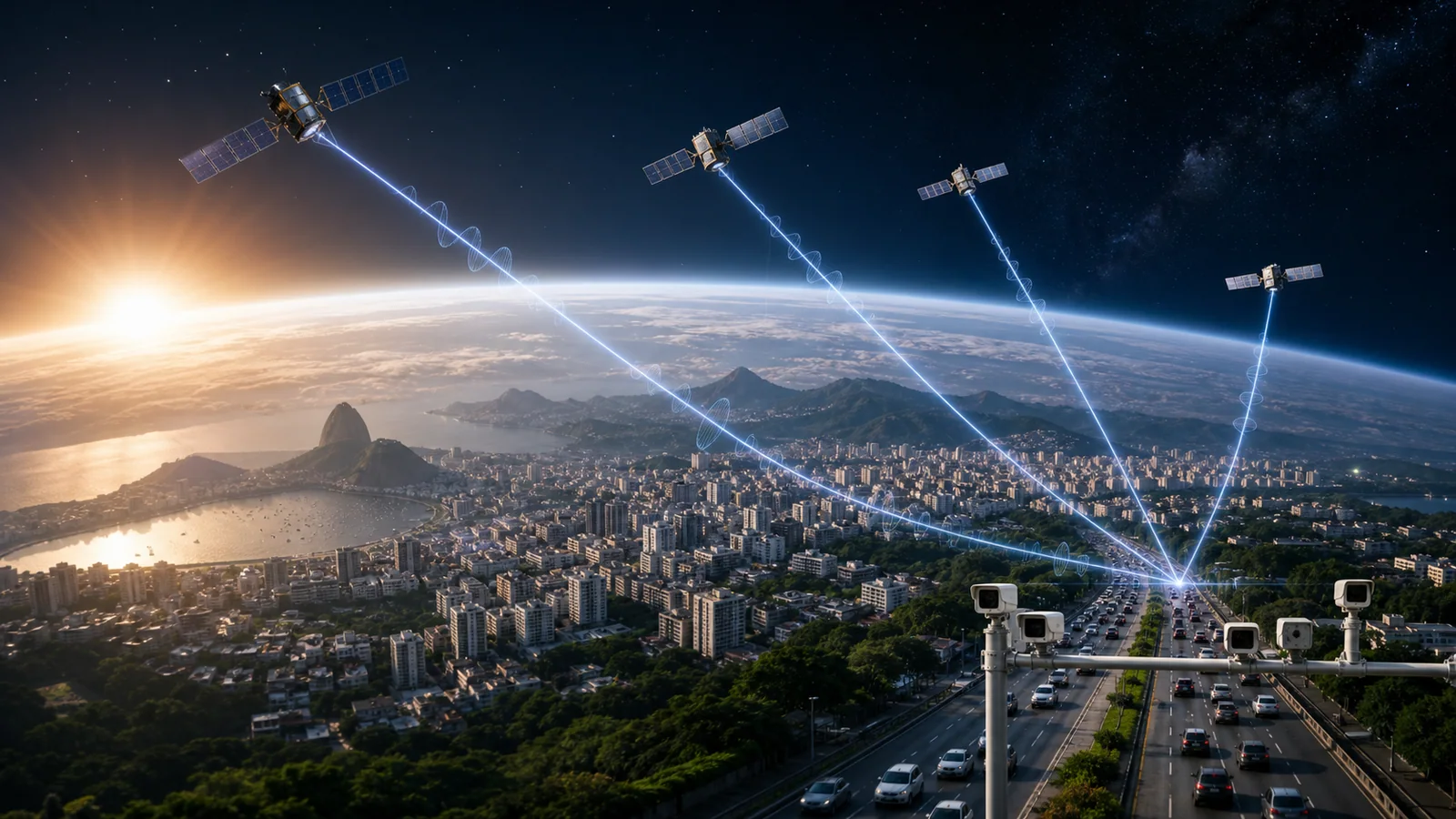
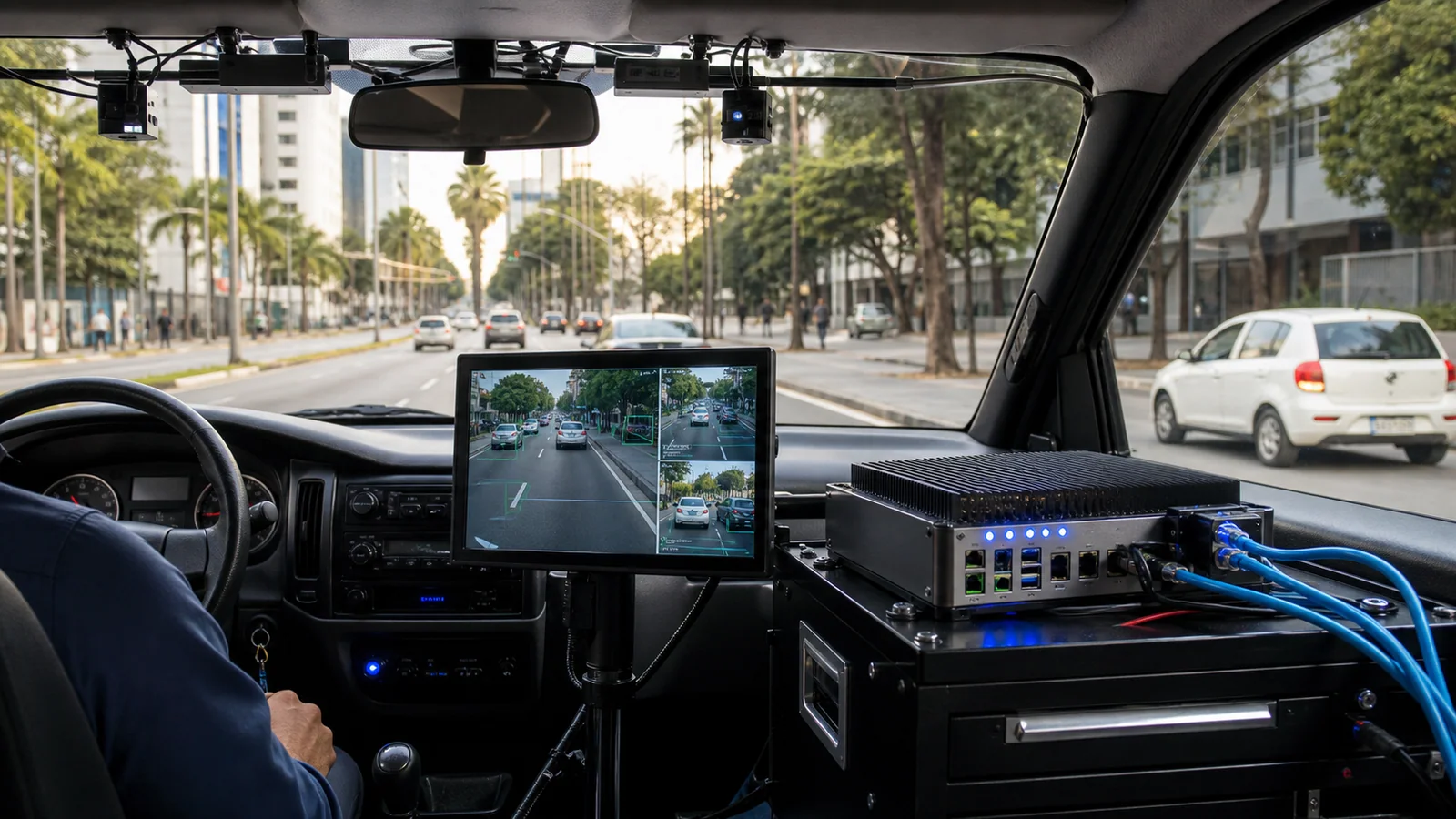
Beyond the physical barrier of the streets, there is a structural obstacle of connectivity. Commercial cloud models require that every video frame captured by enforcement cameras be transmitted over the internet for inference to take place. In cellular signal shadow zones, which are common on the outskirts and expressways of Brazil, the enforcement system would simply stop working. To guarantee the continuity of the public service, Areatec established as a premise that processing should occur in an embedded fashion, directly on the hardware of the Olho Vivo patrol vehicles. This demanded a highly specialized, compact, and efficient model, capable of running without any dependence on an internet connection.
The Architecture of Areatec's Large Mobility Model
The development of the Large Mobility Model began with the rigorous selection of the base model. Areatec's engineering team evaluated several open-source deep neural network architectures, seeking a precise balance between spatial representation capacity and computational resource consumption. The choice fell on a computer vision architecture based on Transformers, optimized for processing temporal sequences of high-speed images. That base was deconstructed and rebuilt to focus exclusively on the geometric and textural characteristics relevant to urban mobility.
Training a model of this magnitude requires a clear definition of which tasks it must perform with mathematical perfection. Instead of teaching the artificial intelligence to recognize millions of objects that are useless for urban management, the model was trained to focus on critical elements. It learned to identify the microgeometry of vehicle plates at extreme angles, to map millimetric deformations in the asphalt that signal the onset of potholes, to assess the integrity of vertical and horizontal signage, and to detect traffic behavior patterns at saturated intersections. This surgical focus allowed the model to reach precision levels superior to those of any generic system, consuming a fraction of the processing power.
The Supreme Challenge of Data Quality
In artificial intelligence engineering, there is a consensus that the algorithm represents only a small part of a project's success. The true competitive differentiator lies in the quality of the data used for training. The greatest challenge for the Areatec team was not writing the lines of code for the compiler or tuning the hyperparameters of the neural network, but rather building and curating a dataset that accurately reflected the reality of Brazilian traffic. Teaching the model to recognize a clean, new plate is a simple task. The technical challenge lies in teaching it to decipher a Mercosul plate partially covered in mud, under the light drizzle of late afternoon, on a cobblestone street.
To overcome that obstacle, Areatec drew on its history of real-world operation, which processes tens of millions of transactions per month. Each image selected for training went through a rigorous process of curation and manual labeling performed by traffic specialists. Scenarios of partial occlusion, extreme shading variations caused by tree canopies, and optical distortions provoked by the vibration of patrol vehicles were introduced. This investment in the quality of the dataset ensured that the Large Mobility Model learned to ignore urban visual noise and to focus strictly on the information vectors needed to generate robust evidence.
Hardware Sovereignty and the Technical Rigor of the LGPD
The decision to maintain its own server infrastructure, located at the research and development center in Araras, was grounded in unavoidable technical and legal reasons. The first of these concerns the General Data Protection Law (LGPD). Images of public roads contain sensitive personal data, such as the faces of pedestrians and vehicle plates that can identify individuals. By processing this information in third-party public clouds, the data controller loses physical control over the information's traffic boundaries, increasing the risk of leaks and regulatory violations. Areatec's own infrastructure guarantees that no non-anonymized data leaves the company's physical security perimeter, meeting the security-by-design requirements demanded by Brazilian law.
Beyond legal compliance, ownership of the infrastructure offers a decisive technical advantage in software optimization. By directly controlling the hardware, Areatec's engineers are able to program the inference code to touch the specific registers and instructions of the graphics processing units (GPUs) directly. This deep integration between software and hardware eliminates the abstraction layers common in generic cloud services, reducing processing latency to less than fifty milliseconds per video frame. This energy and computational efficiency is what makes it feasible to run the model locally and embedded in the vehicles that patrol the streets of Brazilian cities.
Scale and Continuous Training for the Real World
The conclusion of a training cycle does not mean the end of the Large Mobility Model's development. The city is a living organism that changes constantly. New vehicle models are launched, signage standards undergo regulatory changes, and the very wear of urban roads presents new forms of degradation. To maintain the technology's effectiveness, Areatec structured a continuous flow of active learning. The data collected in the field that the model flags with low confidence is automatically isolated, sanitized in compliance with privacy rules, and sent to the Araras infrastructure to feed new fine-tuning cycles.
This closed loop of continuous improvement is what sustains the company's technical reputation in the GovTech market. While theoretical laboratory solutions lose precision as they are exposed to the variations of the real world, Areatec's Large Mobility Model becomes more robust with every kilometer driven. It is this pragmatic engineering, anchored in data sovereignty and direct control over the hardware, that allows the company to deliver high-reliability solutions for public administration, consolidating its commitment to developing technology that works.