Short answer: in Colombia, cepo commonly refers to a device that physically locks a wheel. The phrase cepo virtual, or virtual wheel clamp, is also used to describe digital control that identifies a vehicle, records evidence and supports the rule defined by the authority without immediately attaching hardware to the tyre. They are not the same thing, and the expression does not yet have one nationwide legal meaning.
The distinction matters. A vehicle fitted with OCR cameras does not immobilise a car by itself, decide a penalty or replace an officer and the administrative process. It makes visible what previously depended on a manual patrol: which licence plate was in a road segment, at what time, in which position and whether a valid parking right existed.
Why people use the expression “virtual wheel clamp”
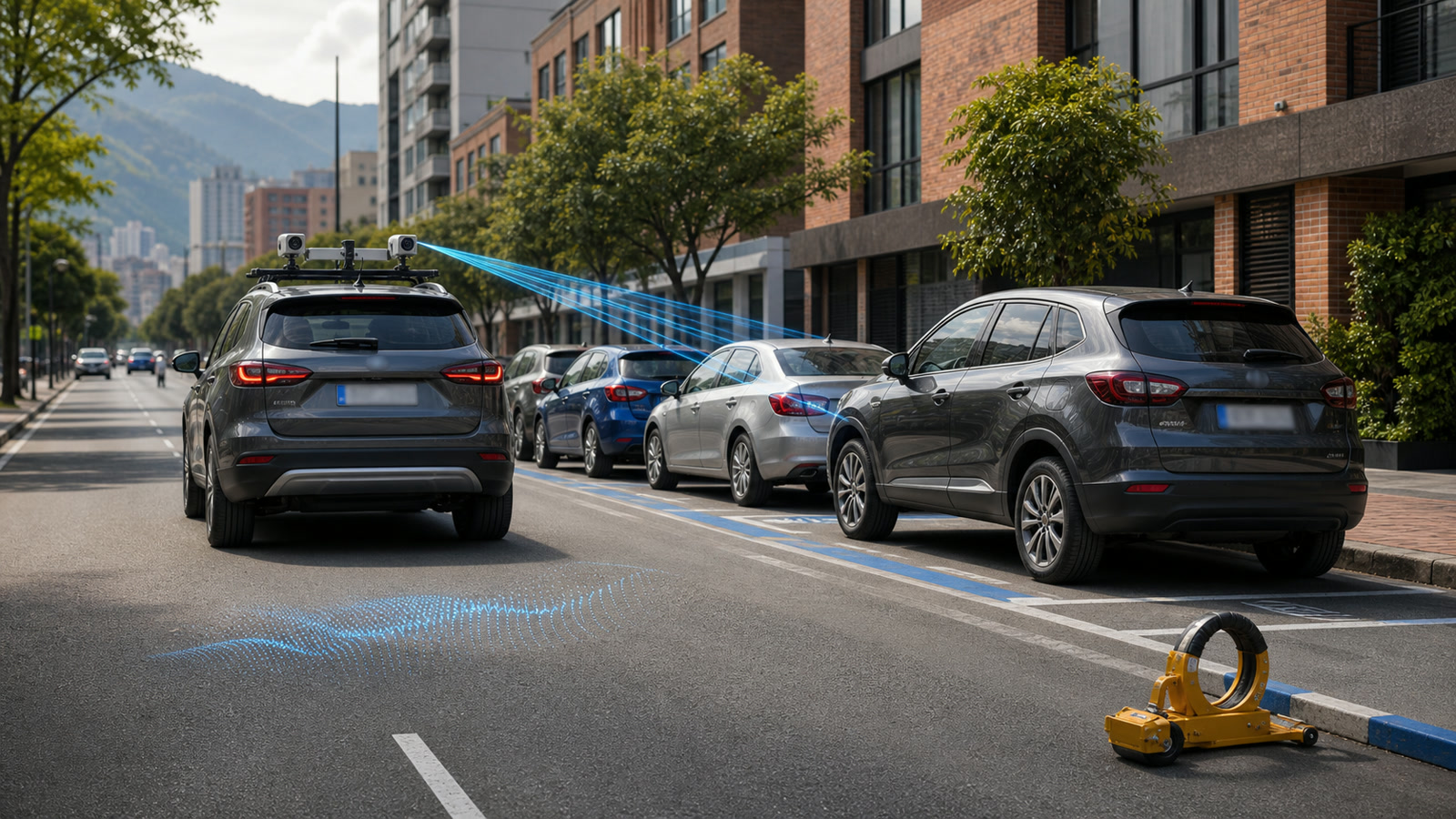
The name comes from a simple comparison. A physical clamp acts on the wheel after a situation covered by the local rule. A so-called virtual clamp acts on information: it records the plate, checks payment or authorisation and creates a case for processing. The first creates a material barrier; the second produces digital evidence.
The wording is contextual. In Bogotá, official information from the Paid Parking Zones uses cepo for the immobiliser fitted to a wheel when the operating conditions communicated to the user have been met. In public debate in Villavicencio, local news coverage used “cepo virtual” for a proposal without physical immobilisation, based on georeferenced photographic records and administrative consequences.
Those examples do not create a national definition. They reveal something more useful to anyone searching the phrase: “virtual wheel clamp” is a language bridge between a familiar device and a digital control operation. In a tender, contract or regulation, the city should move beyond the metaphor and state exactly what will be captured, who may access the data, which authority will decide and what legal effect may follow.
A physical clamp and digital control are not equivalent
| Aspect | Physical wheel clamp | Digital OCR control |
|---|---|---|
| Immediate action | Mechanically locks a wheel. | Records and classifies an observation; it does not block the vehicle. |
| Identification | Depends on an on-street action and its associated record. | Reads the licence plate with OCR/ALPR and preserves the capture context. |
| Coverage | Limited to locations attended by the field team. | Can patrol routes and check large groups of spaces, subject to real street conditions. |
| Outcome | Material immobilisation under the applicable rule. | Evidence for review, guidance, charging, enforcement or audit, according to the local framework. |
| Decision | Belongs to the procedure and competent authority. | Also belongs to the procedure and competent authority; the algorithm does not replace that power. |
How OCR parking control works
The operation begins before the monitoring vehicle enters the street. The city needs an inventory of spaces, road segments, operating hours, tariffs, maximum stays, exemptions and authorisations. Without this regulatory map, a plate reading is only a string of characters.
- Capture: cameras record the parked vehicle during the monitoring route.
- Reading: the OCR/ALPR engine turns the plate image into characters and retains the image required for review.
- Context: the record is associated with date, time, position and operational segment.
- Check: the plate is compared with valid payments, permits, exemptions and rules for that location.
- Processing: valid matches are closed; uncertain or potentially irregular cases follow the workflow defined by the authority.
- Audit: events, reviews and decisions remain connected so that the operation can be reconstructed.
A second pass along the same street adds context. If the rules provide a period to pay, renew or remove the vehicle, two observations separated by an interval help distinguish a recent arrival from an overstay. The interval, grace period and consequence must not be invented by the software. They come from the regulation and the configuration approved by the city.
OCR does not mean an automatic fine
In Colombia, Law 1843 of 2017 regulates automatic, semi-automatic and other technological systems used to detect alleged traffic offences. It includes video cameras and electronic reading equipment capable of accurately identifying a vehicle or driver and establishes requirements for installation and operation.
This does not turn every parking camera into an enforcement system. A platform may use OCR only to verify a payment, measure occupancy or guide a field team. When the purpose becomes detecting an alleged traffic offence, the applicable powers, authorisations, signs and procedures must be followed. The technical architecture must follow the legal framework, not try to replace it.
Colombia's National Traffic Code, as amended by Law 2283 of 2023, mentions wheel clamps or other technologies that fulfil the same purpose in vehicle-blocking cases that warrant immobilisation. This provision does not authorise every OCR reading to be labelled a “virtual clamp”. A concrete deployment requires legal analysis and rules from the competent authority.
What evidence a city needs
An accurately read plate is necessary, but not sufficient. For the record to be useful, the operation must answer straightforward questions:
- Does the image allow the engine's reading to be reviewed?
- Does the position correspond to the regulated segment and space?
- Does the timestamp come from a controlled source and can it be audited?
- Which rule, payment, permit or exemption was checked?
- Who reviewed the case and what decision was made?
- Which retention period applies and who may access the record?
The purpose is not to accumulate images. It is to retain the appropriate amount of data for a justified period, with access control and traceability. A mature operation also separates valid evidence from duplicate images, partly obscured plates, reflections, motorcycles at difficult angles and other situations that require review.
How Areatec technology fits
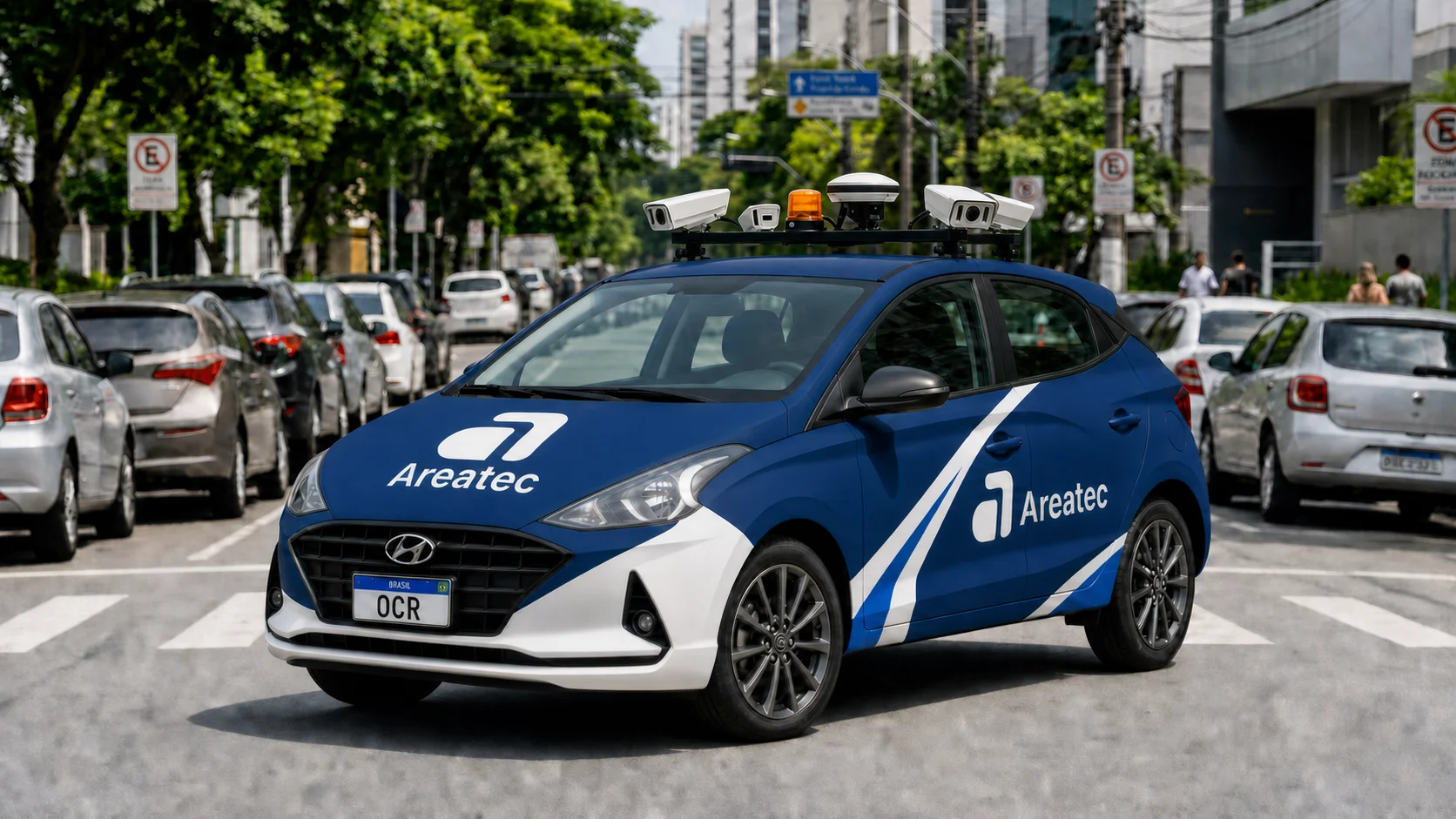
Olho Vivo Patrol is Areatec's vehicle platform for plate reading and mobile enforcement support. It brings together capture, onboard OCR, route operation and record processing for Latin American conditions. It can be integrated with Olho Vivo Parking, which manages the rules, payments and indicators of regulated parking.
Pintrust can add authenticity and freshness controls to the location context, while AreaChain contributes to event traceability and history integrity. These components strengthen the technical chain; they do not confer enforcement powers by themselves or remove the need for review.
“Virtual wheel clamp” starts the conversation because it is easy to remember. To design a serious project, however, the better question is broader: how will the city identify the vehicle, prove the context, apply its rule and make every decision auditable? This is where an OCR car stops being merely a camera on wheels and becomes part of a measurable public policy.
Terms to use in a technical procurement
For an internet search, virtual wheel clamp may be a useful expression. In technical documents, it should be accompanied by less ambiguous terms: mobile OCR enforcement, automatic licence plate recognition, ALPR/LPR, regulated parking control, georeferenced photographic evidence and paid parking zone management.
This vocabulary allows proposals to be compared without relying on a regional nickname. It also prevents incompatible promises, such as saying the system “virtually immobilises” a vehicle while denying any administrative effect. The name may vary; workflow, responsibility and evidence must be explicit.
Sources consulted
- Bogotá Paid Parking Zone: when is the wheel clamp installed?
- Congress of Colombia: Law 1843 of 2017
- Legal information system: Law 769 of 2002, National Traffic Code
- Legal information system: Law 2283 of 2023
- Periódico del Meta: local use of “cepo virtual” in Villavicencio
Frequently asked questions about the virtual wheel clamp
- What is a virtual wheel clamp?
- It is an informal expression for digital controls that identify a vehicle and record evidence without immediately attaching a physical blocker to the wheel. Its actual effect depends on each city's rules and procedure.
- Does an OCR vehicle immobilise a car?
- No. An OCR vehicle captures the plate, context and data required for a check. Any immobilisation, charge or enforcement action depends on the authority and applicable law.
- Are a virtual clamp and an automated traffic ticket the same thing?
- No. Virtual clamp is a contextual term, while technology-based detection of alleged traffic offences is specifically regulated. OCR can also be used only for payment control, occupancy measurement or operational support.
- What do OCR and ALPR mean in parking?
- They refer to the automatic reading of licence plates from images. The result is combined with location, time and segment rules to check payments, permits and possible cases.
- Does reading a plate automatically generate a fine?
- Not by itself. The reading is an input. Validation, legal classification and procedure belong to the competent authority and must follow the applicable rules.
- What should a city require from digital parking control?
- Capture quality, reviewability, correct association with place and time, data protection, access control, traceability, configurable rules and a clear boundary around human and administrative decisions.