When a traffic fine arrives by mail or appears in a digital driver app, the reaction is often immediate: frustration, suspicion and the feeling that the system exists only to collect money. The driver questions the amount, looks for a formal defect in the notice and tries to reduce the penalty to a mere administrative bill.
But the legal reality is deeper. A traffic fine is not a recent invention of city hall and it is not simply a revenue mechanism. It carries a historical lineage that runs through Roman law, continental European legal tradition and Brazil's Traffic Code. The financial impact is part of the logic of the sanction.
A fine is designed to hurt. That financial discomfort is a coercive tool intended to protect the collective agreement behind public roads: everyone gives up a small portion of individual convenience so everyone can move safely.
Ius puniendi: the legal root of the fine
To understand why a traffic violation becomes a monetary penalty, we need to go back to the Roman concept of ius puniendi: the right to punish. The State holds the legitimate monopoly on force. No one may take justice into their own hands; in exchange, public authority assumes the responsibility to preserve order and apply sanctions when rules are violated.
In Rome, magistrates exercised imperium and potestas, meaning public authority and delegated power to command, restrict and punish. Monetary sanctions already worked as instruments of punishment and restoration of order. The logic was simple: whoever breaks the common rule must face a concrete consequence.
This legal matrix crossed the Middle Ages, was preserved by medieval Italian law and gained modern form in the penal codes of unified Italy. Brazil, as part of the Roman-Germanic legal tradition, inherited this sanctioning structure in public law.
From Roman law to the Brazilian Traffic Code
The Brazilian Traffic Code, Law No. 9,503/1997, is a contemporary expression of that power to punish. A public road is a collective asset. When someone runs a red light, parks in a prohibited place or drives under the influence, they are not merely violating a bureaucratic rule: they are breaking a social pact of road safety.
This is where administrative sanctioning law comes into play. A traffic fine is not a disguised tax and should not be confused with a parking fee, a post-use parking tariff or a civil collection charge. It is an administrative penalty, created by law, applied through a specific procedure and subject to due-process guarantees.
Its purpose is not simply to collect money. Its purpose is to preserve public order in the road environment, where a single wrong individual decision can create immediate collective risk.
The three functions of a traffic fine
A monetary penalty performs three central functions. The first is punitive: the person who violated the rule suffers a financial setback. The second is deterrent: the fear of losing money reduces the chance of repeating the behavior. The third is educational: the economic impact reinforces, in concrete terms, that the conduct cannot be normalized.
Proportionality appears in the gradation of Brazil's Traffic Code. Minor, medium, serious and very serious violations have different amounts because they represent different levels of risk. Running a red light is treated as very serious because the potential harm is far greater than a low-risk formal violation. In extreme cases, such as driving under the influence, the amount can be multiplied to increase the deterrent effect.
The State intentionally applies a heavier hand when social risk is high. That is the essence of administrative traffic enforcement.
Electronic enforcement does not change the nature of the sanction
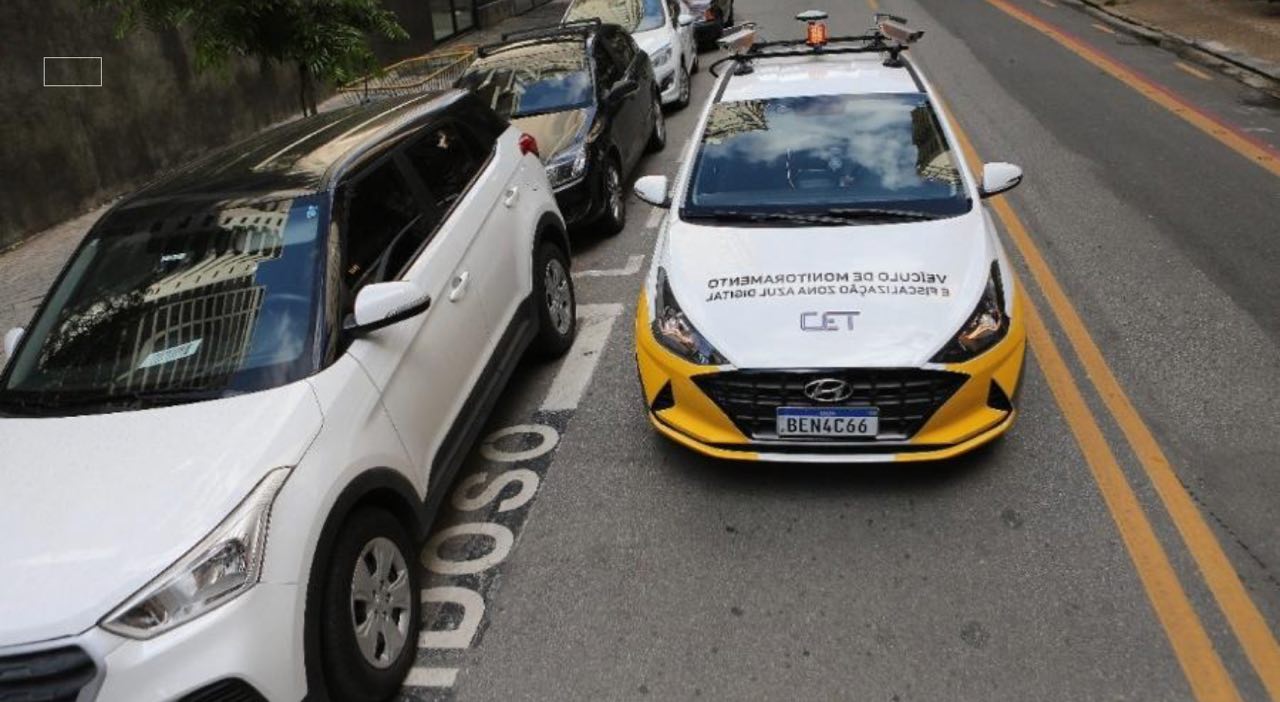
In daily enforcement operations across Brazilian cities, modern technology only makes an old legal process faster, more traceable and more auditable: identify the conduct, record the evidence, validate the violation and apply the penalty when there is legal basis.
Olho Vivo Patrol, electronic ticketing, Pintrust authenticated geolocation and AreaChain digital chain of custody do not create a new right to punish. They strengthen the evidence, reduce subjectivity, organize the digital chain of custody and provide greater legal certainty to the administrative procedure.
The traffic officer is not there to persecute citizens. The officer is the operational edge of public authority. The rule exists; the violation of the rule generates a consequence; and technology helps document that consequence with precision.
Why does the fine weigh differently for each person?
A common criticism is that a traffic fine affects people differently depending on income. For some, a fixed fine is an inconvenience. For others, it can compromise a monthly budget. Legislative proposals occasionally suggest linking fines to the driver's income, and that debate is legitimate.
But it does not eliminate the legal core of the issue: financial coercion remains one of the State's most universal languages for discouraging dangerous behavior. Without a concrete consequence, traffic rules become advice. Advice alone does not organize urban chaos.
The payment notice as public authority made visible
A traffic fine notice is not merely a bill. It is the visible result of a legal chain that begins with the collective duty of safety, passes through ius puniendi, finds legal basis in traffic law and ends in an administrative penalty applied to a concrete case.
The next time a driver sees a traffic officer, an enforcement camera or an automatic license plate recognition system, it is worth remembering: behind that equipment stands a millennia-old legal history. Ius puniendi is still alive, now mediated by technology, digital evidence, authenticated geolocation and chain of custody.
Whether we like it or not, this is part of what helps everyone get home alive at the end of the day.
FAQ: traffic fines, sanctions and electronic enforcement
- Is a traffic fine a tax?
- No. A traffic fine is an administrative penalty created by law. It follows from a violation and has punitive, deterrent and educational purposes.
- What does ius puniendi mean?
- Ius puniendi is the Latin expression for the right to punish. In traffic enforcement, it appears when the State applies sanctions to protect public order and road safety.
- Does electronic enforcement issue fines by itself?
- Technology records evidence, organizes data and reduces subjectivity. The penalty remains tied to administrative procedure, competent authority and legal defense guarantees.