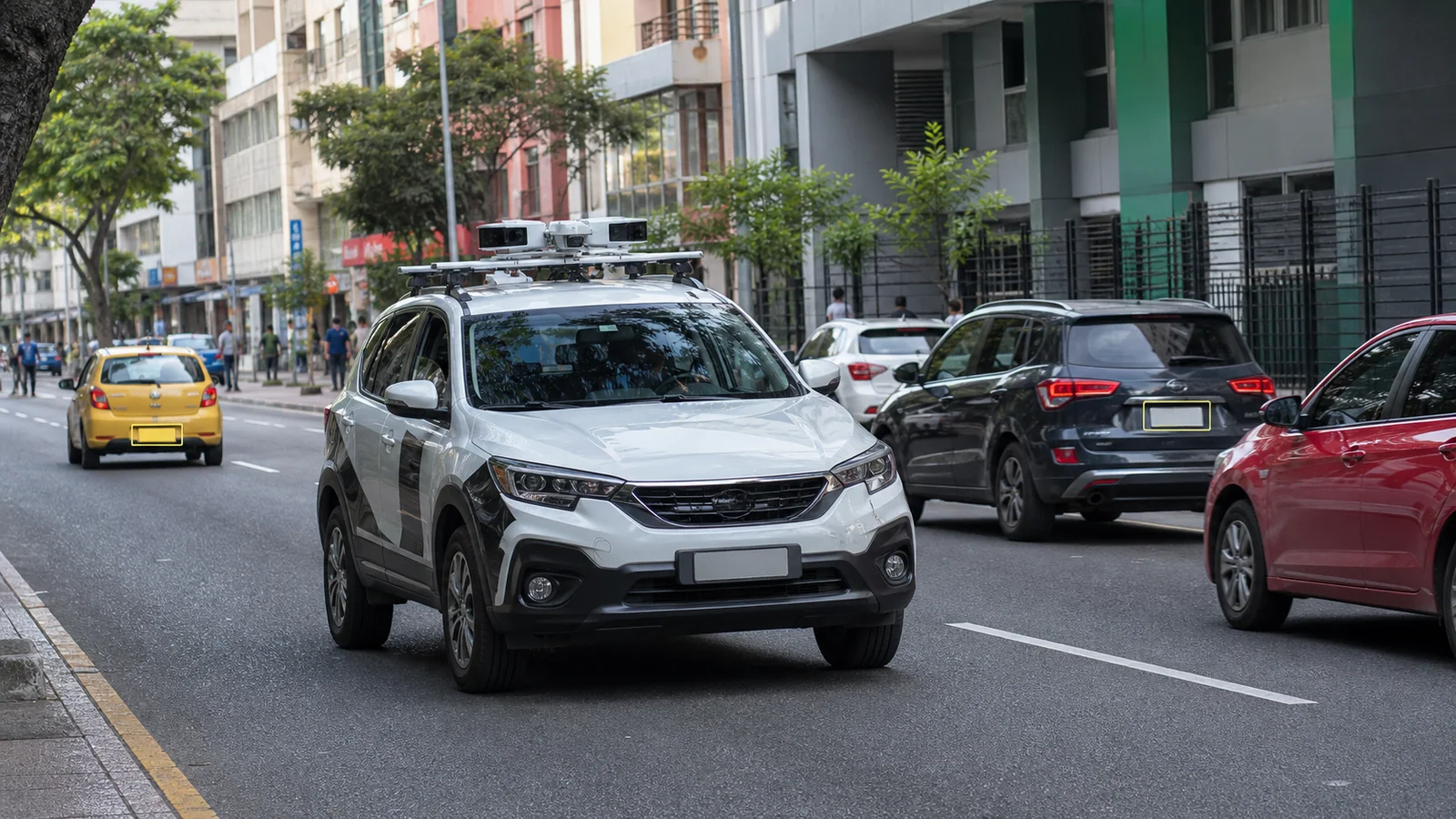
The twilight of a rainy day in a Brazilian metropolis brings the usual chaos of gleaming metal, wet asphalt, and the diffuse glare of red taillights. Beneath the storm lashing the avenue, an enforcement vehicle glides silently along. On its roof, compact cameras scan the surroundings. In fractions of a millisecond, dirty, dented license plates, captured at unforgiving angles and battered by water droplets, are deciphered with surgical precision. To the casual observer, it looks like contemporary magic. To the engineers who devote their lives to deciphering the handwriting of machines, it is the climax of a saga that has spanned centuries, defied the limits of mathematics, and demanded the rewriting of code in its purest, most visceral form.
This journey did not begin in the gleaming offices of Silicon Valley, nor at the modern drawing boards of traffic engineering. It dates back to a time when computers were mechanical gears and electricity itself was still in its infancy as the driving force of industry. Optical Character Recognition, now known universally by the acronym OCR, was born from a deeply humanitarian desire: to give voice to books so that the blind could read.
From Gears to Light: The Prehistory of the Mechanical Eye
In 1870, American inventor Charles Carey filed a revolutionary patent for what he called the “retina scanner” [1]. It was a rudimentary mosaic of photocells that attempted to mimic the structure of the human eye in order to transmit images. Although the technology of the era did not allow for the practical construction of his invention, Carey planted the seed of the idea that machines could, in some way, perceive the visual world. Decades later, in 1912, Irish physicist Edmund Fournier d’Albe developed the Optophone [2]. The device used selenium sensors to convert the printed characters of a page into distinct musical tones. A blind person, after extensive training, could “hear” the words and decipher the written text.
The leap toward automation came in 1931 with Emanuel Goldberg’s “Statistical Machine” [3]. His system used photoelectric cells to search microfilm through optical templates. If the light pattern matched the character on the mask, the circuit closed, recording the reading. It was the first time a machine made decisions based on printed characters, attracting IBM, which acquired the patent foreseeing the future of data entry.
| Year | Inventor / Organization | Technological Innovation | Impact on the Development of OCR |
|---|---|---|---|
| 1870 | Charles Carey | Retina Scanner | First theoretical concept of photocells mimicking human vision [1]. |
| 1912 | Edmund Fournier d’Albe | Optophone | Conversion of printed characters into sound tones for the visually impaired [2]. |
| 1931 | Emanuel Goldberg | Statistical Machine | Use of photoelectric cells and optical templates, acquired by IBM [3]. |
| 1951 | David Shepard | GISMO | First commercial OCR machine capable of reading characters and translating Morse code [4]. |
| 1974 | Ray Kurzweil | Omni-Font OCR | Algorithm capable of reading any typeface without prior training [5]. |
| 1989 | Yann LeCun (Bell Labs) | LeNet-1 | First convolutional neural network applied to digit recognition [6]. |
| 1998 | Yann LeCun (Bell Labs) | LeNet-5 | Consolidation of deep learning applied to document recognition [7]. |
After World War II, the need to process mountains of correspondence and financial reports forced the technology out of the conceptual realm. In 1951, American cryptanalyst David Shepard built a machine in his attic dubbed GISMO [4]. The device was capable of reading characters printed on a standard typewriter and converting them into Morse code for telegraphic transmission. Shepard founded Intelligent Machines Research Corporation (IMR), which in 1954 delivered the world’s first commercial OCR system to Reader’s Digest magazine [1]. The machine read typed sales reports and automatically converted them into punched cards, eliminating operational bottlenecks that had delayed the magazine’s distribution by weeks.
The major bottleneck of these early systems was rigidity. If a letter was slightly misaligned, or if the font changed, the machine failed miserably. It was only in 1974 that legendary inventor Ray Kurzweil developed the first omni-font OCR software [5]. Kurzweil’s algorithm did not search for exact matches against physical templates; it analyzed the geometric properties of characters — identifying loops, vertical strokes, and intersections. Coupled with a flatbed scanner and a voice synthesizer, the Kurzweil Reading Machine was presented to the world in 1976 as a definitive milestone in the inclusion of the visually impaired. Stevie Wonder himself was one of the first buyers of the machine, symbolizing the triumph of engineering over darkness.
The French Connection: Yann LeCun and the Convolutional Network Revolution
Despite the commercial success of Kurzweil’s OCR in offices, the streets presented a challenge of an entirely different nature. Characters printed on paper under the controlled light of a scanner are one thing; metal plates in motion, covered in dust, under torrential rain and lit by unstable headlights, are another. Traditional OCR, based on geometric heuristics and image thresholding, crumbled under urban dynamism. The world needed a new paradigm of artificial intelligence.
This is where history dispels a common myth. Yann LeCun, the brilliant French computer scientist and winner of the 2018 Turing Award, is often credited with inventing OCR. LeCun did not invent OCR — as we have seen, the technology had already accumulated decades of commercial use before he graduated. LeCun’s monumental contribution was the creation of Convolutional Neural Networks (CNNs), the mathematical architecture that enabled OCR to take an unprecedented evolutionary leap, empowering machines to learn to see in a manner similar to living beings [6].
In the late 1980s, working at the AT&T Bell Labs facilities in New Jersey, LeCun was obsessed with solving the problem of handwriting recognition. The computers of the time tried to extract visual features manually designed by engineers, a slow, inefficient, and failure-prone process. LeCun drew inspiration from neuroscientific discoveries about the visual cortex of mammals, which processes information hierarchically, starting from simple edges and textures and progressing to complex shapes.
In 1989, LeCun introduced LeNet-1, the first functional convolutional network [6]. Instead of telling the machine what a vertical line or a curve was, the neural network learned these features on its own, adjusting millions of synaptic connections through the backpropagation algorithm (backpropagation). The system was put to the real-world test by the United States Postal Service (USPS), automatically reading handwritten ZIP codes on millions of envelopes that passed through sorting centers daily.
[Input Image (32x32)]
         │
         ▼
[Convolution Layer (C1)] ──► Extracts basic feature maps (edges, lines)
         │
         ▼
[Subsampling Layer (S2)] ──► Reduces spatial resolution (tolerance to rotations/noise)
         │
         ▼
[Convolution Layer (C3)] ──► Combines basic features into complex shapes
         │
         ▼
[Subsampling Layer (S4)] ──► Further resolution reduction
         │
         ▼
[Fully Connected Layers (F5/F6)] ──► Final character classification
         │
         ▼
[Output: Identified Character (0-9, A-Z)]
In 1998, the publication of the seminal paper “Gradient-Based Learning Applied to Document Recognition” consolidated the LeNet-5 architecture [7]. The technology was so robust that NCR Corporation integrated it into its bank check reading systems. By the mid-1990s, these systems silently processed millions of checks every day in bank branches across the United States, recording incredibly low error rates. LeCun proved that deep learning (deep learning) was not merely an elegant academic theory, but a tool of the highest industrial reliability.
From Asphalt to Code: The Birth of ALPR on the Streets of Britain
While LeCun refined his neural networks in American laboratories, on the other side of the Atlantic, the British police faced an existential threat. In the 1970s, the bomb attacks of the Irish Republican Army (IRA) plagued the cities of the United Kingdom. Border control and the rapid identification of vehicles became national security priorities.
In 1976, scientists at the Police Scientific Development Branch (PSDB) invented Automatic License Plate Recognition (ALPR, or ANPR in European parlance) [8]. The first functional prototypes were installed in 1979 at the Dartford Tunnel, a critical crossing point of the River Thames, to identify stolen vehicles and monitor the movements of terrorism suspects. The first arrest made directly through the technology occurred in 1981, when the system triggered an alert for a stolen car crossing the tunnel, allowing the patrol to intercept the driver minutes later [9].
The true commercialization of the technology began with the founding of Computer Recognition Systems (CRS) in 1981 by Bill Adaway [10]. CRS adapted computer vision systems used in industrial quality control to process video signals from traffic cameras in real time. In 1993, after a devastating IRA attack in the financial heart of London, the metropolitan police erected the “Ring of Steel” [9]. A dense network of physical barriers and cameras equipped with the CRS ALPR system was positioned at every entrance to the City of London. Any vehicle crossing the perimeter had its plate read, recorded, and checked against intelligence databases within seconds, suffocating the operational capacity of the terrorists in the region.
In 1993, British traffic engineering applied ALPR for civilian use to enforce speed limits in the roadworks of the M20 motorway, creating the Speed Violation Detection Deterrent (SVDD) [10]. Two cameras recorded plates at the entrance and exit of the stretch, calculating the average speed based on the elapsed time. Without issuing fines, since the system lacked official certification, it displayed the plate and speed of the offender on electronic panels. The psychological impact was overwhelming: within two weeks, speeding violations dropped from 36.3% to 17%, protecting the road workers.
The Reality of Brazilian Streets: Areatec’s Manifesto against “Off-the-Shelf Code”
When we bring this technology to the Brazilian scene, the elegant theory of European and North American laboratories collides with the harshness of the real world. In Brazil, vehicle OCR encounters plates covered in dust from dirt roads, metal plates dented by parking collisions, reflective films worn out by the merciless midday sun, tropical storms that distort the image, and extreme capture angles imposed by the geometry of our roads.
For Areatec, the national leader in traffic enforcement technology, the realization was immediate: off-the-shelf OCR algorithms, developed by multinational giants based on controlled European scenarios, were incapable of operating with the reliability demanded by Brazilian legal certainty. Using these ready-made solutions meant accepting a flood of false positives, unread plates, and lawsuits over wrongful citations.
Areatec’s response to this challenge was an act of technological rebellion and engineering purism. Instead of packaging ready-made third-party computer vision libraries, the company’s research and development team decided to develop its own license plate interpretation algorithm. This was not about writing high-level lines of code in generic frameworks; Areatec’s engineers leaned over the keyboard to write the algorithm literally “polishing bits”.
“Polishing bits” is the technical jargon that separates ordinary programmers from the artisans of silicon. It means programming at a low level, directly manipulating memory registers, optimizing the use of the processors’ vector registers, and designing execution pipelines that extract every last drop of performance from the hardware without wasting a single clock cycle.
This obsession with extreme optimization produced an unparalleled computer vision engine. While a traditional OCR consumes massive resources from high-cost graphics processors (GPUs) and requires robust servers to operate, Areatec’s proprietary algorithm performs the miracle of ultra-high-speed edge processing directly on the embedded hardware of the enforcement vehicles. The entire pipeline of detection, segmentation, perspective correction, and character classification occurs locally, on the very roof of the car, without relying on stable cloud connections to make decisions.
This digital brain is powered by Aretron, Areatec’s artificial intelligence engine [11]. Its proprietary training gives greater weight to difficult and rare field cases instead of allowing common scenes to dominate learning. In urban enforcement, this helps separate the plate and the relevant occurrence from buildings, pedestrians, trees, asphalt and the other elements that make up most of the visual stream.
Areatec’s OCR ecosystem operates in perfect synergy with the company’s field solutions:
- Olho Vivo Patrol: Vehicles equipped with the high-speed camera system perform continuous scanning of urban roads, processing dozens of plates simultaneously at speeds of up to 80 km/h [13].
- Electronic Ticketing: Portable devices in the hands of traffic agents, integrated with the OCR engine, allowing instant queries and precise citations with a single tap.
- Digipare: The digital paid-parking platform that communicates in real time with the enforcement vehicles, cross-referencing the data of read plates against the database of active vehicles to validate parking compliance without interrupting the flow of traffic.
To ensure that no violation is recorded unjustly, Areatec implemented a rigorous double-verification protocol in its system. The OCR vehicle performs the first reading and identifies the irregularity (such as the lack of payment for paid parking). Instead of issuing the citation immediately, the system geo-references the occurrence and schedules a second pass of the enforcement vehicle after the legal tolerance interval. Only if the irregularity persists on the second reading is the case forwarded for final validation by a public agent. This workflow guarantees full legal certainty for the process, eliminating the risk of unjust penalties for quick stops to drop off and pick up passengers [14].
In addition, the integrity of the data collected on the streets is protected by the DATARACE protocol, a proprietary hybrid communication technology developed by Areatec [12]. DATARACE constantly monitors the quality of the cellular network (3G/4G/5G) in the so-called “shadow zones” of cities. When the connection is unstable, the protocol dynamically switches between TCP mode (guaranteeing reliable delivery) and UDP mode (prioritizing speed), ensuring that the data packets of violations and the evidentiary images reach the control center without corruption or loss of information, even under the worst connectivity conditions.
The Next Frontier: The Vehicle’s Literal Fingerprint
Absolute mastery over reading the characters on plates is merely Areatec’s present. The company’s engineering is already aiming at the technological horizon of the next decade. The metal plate, after all, is a fragile element of identification. It can be cloned, tampered with using electrical tape, stolen from another automobile, or simply concealed by criminals. To achieve true road safety and intelligent city management, the enforcement system cannot rely exclusively on seven characters stamped onto an aluminum plate.
Areatec’s vision of the future is the creation of the vehicle’s literal fingerprint. The goal of the field research is to train Aretron to identify an automobile not by what it carries hanging from its bumper, but by who it essentially is.
[Multimodal Video Capture Flow]
         │
         ├──► Traditional OCR Reading (Plate: ABC1234)
         │
         └──► Vehicle Biometric Identification Pipeline (Aretron)
                  │
                  ├──► Volumetric Analysis (Exact body shape)
                  ├──► Dynamic Chromatography (Precise color spectrum under current light)
                  ├──► Micro-Defect Mapping (Scratches, dents, windshield cracks)
                  └──► Accessory Signature (Stickers, roof racks, custom hubcaps)
                           │
                           ▼
                  [Generation of the Unique Biometric Signature (Cryptographic Hash)]
                           │
                           ▼
                  [Cross-Validation in the Database]
                           │
                           ├──► Total Match ──► Regularized Vehicle
                           └──► Divergence (Plate ABC1234 on car with different biometrics)
                                    │
                                    ▼
                           [CLONE / TAMPERING ALERT IN REAL TIME]
Imagine a computer vision algorithm capable of mapping the exact volumetry of a car’s body, identifying the model with millimeter precision. The system analyzes the exact spectrum of the paint color, maps the presence of specific stickers on the rear window, detects the wear pattern of the hubcaps, records a subtle scratch on the left fender and a small crack in the upper corner of the windshield.
These combined characteristics generate a unique biometric signature — an inviolable cryptographic hash that functions as the automobile’s fingerprint. If a criminal clones the plate of a regularized vehicle and installs it on an identical car to commit crimes, Aretron will detect the fraud instantly. Upon crossing the cameras, the system will perceive that, although the plate points to a regular model, the biometric signature of the vehicle crossing the road does not correspond to that of the original automobile registered in the system. The cloning alert is issued to public security forces within milliseconds, before the vehicle can even get away.
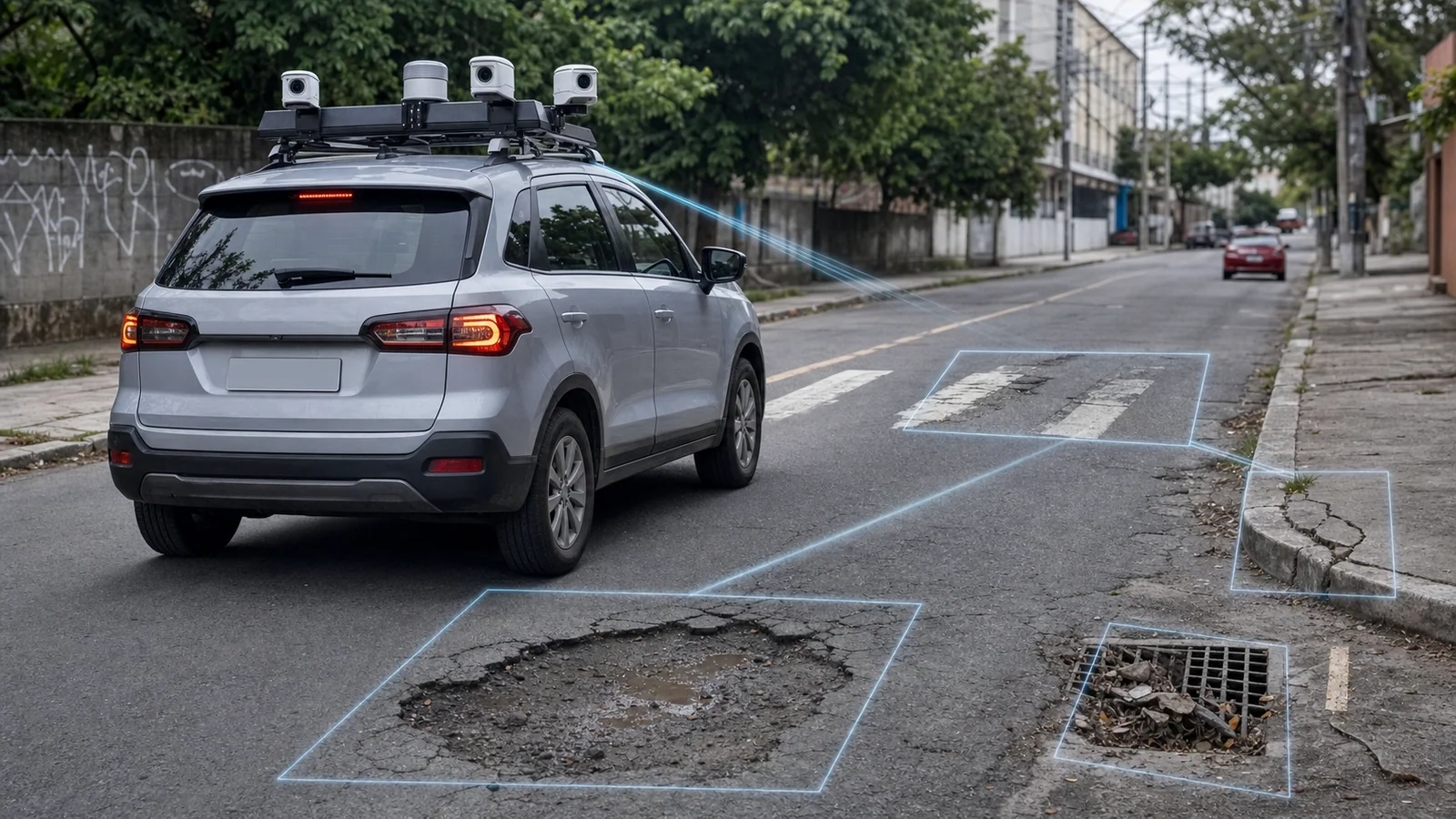
This technology transforms traffic enforcement into a tool for collaborative urban stewardship on a monumental scale. Integrated into the smart-city ecosystem, Areatec’s OCR vehicle ceases to be a mere detector of parking violations and becomes the central nervous system of the municipality. As it sweeps the streets, the car maps potholes in the asphalt, identifies burned-out streetlamp bulbs, detects traffic signs obscured by tree branches, and records irregular accumulations of trash on the sidewalks, automatically opening service requests with the responsible departments before citizens even have time to complain [15].
The technology that works in the real world is not the one that operates flawlessly in the sterile conditions of an academic laboratory. It is the one developed by engineers who know the dust of the roads, the weight of tropical rain, and the responsibility of guaranteeing justice and legal certainty in every line of code written. By polishing bits to create its own digital eye, Areatec has not only honored the legacy of the OCR pioneers; it has paved the way for the cities of the future to be managed with the precision, intelligence, and humanity that modern urban mobility demands.
References
- SCHANTZ, Herbert F. The History of OCR: Optical Character Recognition. Recognition Technologies Users Association, 1982.
- FOURNIER D'ALBE, Edmund Edward. On a Type-Reading Optophone. Proceedings of the Royal Society of London. Series A, vol. 90, no. 619, p. 373-375, 1914. Available at: doi.org.
- GOLDBERG, Emanuel. Statistical Machine. US Patent 1,838,389, issued Dec. 29, 1931. Available at: Google Patents.
- SHEPARD, David Hammond; COOK JR., Harvey. Apparatus for Reading Document Characters. US Patent 2,663,758, issued Dec. 22, 1953. Available at: Google Patents.
- HAUGER, J. Scott. Reading Machines for the Blind. Blacksburg: Virginia Polytechnic Institute and State University, 1995.
- LECUN, Yann et al. Backpropagation Applied to Handwritten Zip Code Recognition. Neural Computation, vol. 1, no. 4, p. 541-551, 1989. Available at: doi.org.
- LECUN, Yann et al. Gradient-Based Learning Applied to Document Recognition. Proceedings of the IEEE, vol. 86, no. 11, p. 2278-2324, 1998. Available at: yann.lecun.com.
- ROBERTS, David J. Automated License Plate Recognition (ALPR) Use by Law Enforcement. National Institute of Justice, 2012. Available at: ojp.gov.
- BRENNAN CENTER FOR JUSTICE. Automatic License Plate Readers: Legal Status and Policy Recommendations. New York: Brennan Center, 2020. Available at: brennancenter.org.
- HILL, Geoffrey. FEATURE: Who invented ANPR? The untold British story behind a global traffic technology revolution. Traffic Technology Today, Apr. 9, 2026. Available at: traffictechnologytoday.com.
- AREATEC. Aretron: the artificial intelligence engine behind Olho Vivo. Areatec Blog, Jan. 22, 2026. Available at: areatec.com.br.
- AREATEC. Institutional memory and operational guidelines. Internal Engineering and R&D Manual, 2026.
- AREATEC. Olho Vivo Patrol: The Brain on Wheels that Transforms Urban Management. Areatec Blog, May 23, 2026. Available at: areatec.com.br.
- MOTTA, Luis. How OCR Enforcement Transforms the Management of Paid Parking. Areatec Blog, May 29, 2026. Available at: areatec.com.br.
- AREATEC. Urban Stewardship with OCR Vehicles: Intelligent Monitoring of Cities. Areatec Blog, Apr. 1, 2026. Available at: areatec.com.br.