Back to blog
Tecnologia e Segurança March 5, 2026

AreaChain: private blockchain for digital chain of custody

Fábio Eduardo Cressoni Batistella

AreaChain: private blockchain for digital chain of custody

The Challenge of Systematic Doubt

Anyone working in the development of technology focused on public enforcement and legal certainty is familiar with a recurring question. Since Areatec was founded three decades ago, our engineering team has faced the same objection raised by defense attorneys, auditors, and skeptical managers: "what your systems produce has no legal standing and can be manipulated by anyone — after all, it is just data written into a database."

We heard this phrase back in the 1990s, when our first traffic and parking control systems were written in the Clipper 5.2 programming language and used dBASE (.dbf) files to store records. In that era of personal computing, any user with a simple text editor or a terminal tool could open the data file and alter an infraction record or a parking timestamp without leaving any physical or digital trace of the modification.

  +-------------------------------------------------------------+
  |               THE EVOLUTION OF DATA STORAGE                 |
  |                                                             |
  |  [ 1990s: Clipper 5.2 / dBASE (.dbf) ]                      |
  |    -> Flat files with no access control                     |
  |    -> Easily editable from any terminal                     |
  |         v                                                   |
  |  [ 2000s-2010s: Relational Databases (SQL) ]                |
  |    -> Introduction of WAL, Triggers and Row-Level Security  |
  |    -> Robust internal security, but trust-dependent         |
  |         v                                                   |
  |  [ 2020s: AreaChain Ecosystem (Blockchain) ]                |
  |    -> External mathematical immutability                    |
  |    -> Proof of non-tampering independent of any audit       |
  +-------------------------------------------------------------+

Our engineering followed the global technological evolution. We migrated from Clipper and dBASE to modern client-server architectures, adopting robust relational databases. We implemented advanced internal security features, such as transaction logs recorded before the physical write (Write-Ahead Logging - WAL), automatic audit triggers, encrypted audit trails, and strict Row-Level Security (RLS) policies.

Even with these technical defenses that prevented unauthorized access by external operators, the underlying question persisted in the business environment and in the courts: "who guarantees that Areatec's own database administrator, or a programmer with root access to the server, did not alter a record to benefit or harm someone?"

This doubt, although natural in the field of the right to defense, attacked the reputation for integrity that we built over thirty years of operating in the Brazilian market. We understood that it was not enough to adopt good IT governance practices or to sign confidentiality and technical compliance agreements. We had to change the paradigm of trust.

"It is not enough to merely state that we are honest and that our internal processes are carried out correctly. We need to prove it in an irrefutable way, and the best way to do that is by using the laws of mathematics." — Fábio Eduardo Cressoni Batistella, CEO of Areatec

This strategic directive guided our Research and Development division to seek a solution that would remove the human factor from the equation of trust. The natural path of this search was the development of AreaChain, Areatec's private and permissioned blockchain network, designed specifically to guarantee the absolute integrity of the digital evidence generated by our enforcement and urban maintenance systems.

The Anatomy of Mathematical Proof: What AreaChain Is

To understand how AreaChain works, it is necessary to dispel a common confusion in the technology market. The word "blockchain" is frequently associated with public cryptocurrencies, such as Bitcoin or Ethereum. These public networks operate in a permissionless model, where any computer in the world can connect, validate transactions, and mine blocks by spending large volumes of electrical energy to solve artificial mathematical problems.

AreaChain adopts a completely different architecture. It is a private and permissioned blockchain. In this structure, access to the network is controlled and the validator nodes are operated by known and auditable entities, such as Areatec itself, public enforcement agencies, technology institutes, and independent forensic offices.

This design choice eliminates the need for intensive mining processes, allowing the network to process tens of thousands of transactions per second with minimal latency, meeting the scale required by systems that manage millions of traffic events every month.

  +-------------------------------------------------------------+
  |              STRUCTURAL DIFFERENCES IN BLOCKCHAIN          |
  |                                                             |
  |  [ Public Blockchain ]          [ Private Blockchain ]     |
  |    - Open to any node             - Controlled access      |
  |    - Intensive mining (PoW)       - Consensus w/o mining   |
  |    - Focus on crypto assets       - Focus on integrity     |
  |    - High latency                 - Very high speed        |
  +-------------------------------------------------------------+

The immutability of data in AreaChain is guaranteed by a sequence of cryptographic concepts that work in an integrated way:

1. Cryptographic Hashing with the SHA-256 Algorithm

The security foundation of AreaChain rests on the 256-bit Secure Hash Algorithm (SHA-256) dispersion algorithm. This mathematical function acts as a unique digital signature for any volume of information. It receives a data file of any size — whether an infraction image captured by an OCR vehicle, a geolocation coordinate, or a parking payment record — and transforms it into a fixed sequence of 64 hexadecimal characters.

SHA-256 has two fundamental properties for digital forensic analysis:

  • Unidirectional Irreversibility: It is mathematically impossible to perform the reverse path. An expert who possesses only the 256-bit hash code cannot reconstruct the original data file from it.
  • Avalanche Effect: Any microscopic change to the input file — such as modifying a single letter on a vehicle license plate or a single digit in a date stamp — completely changes the resulting hash, generating a totally different signature and instantly exposing the fraud attempt.

2. Block Chaining

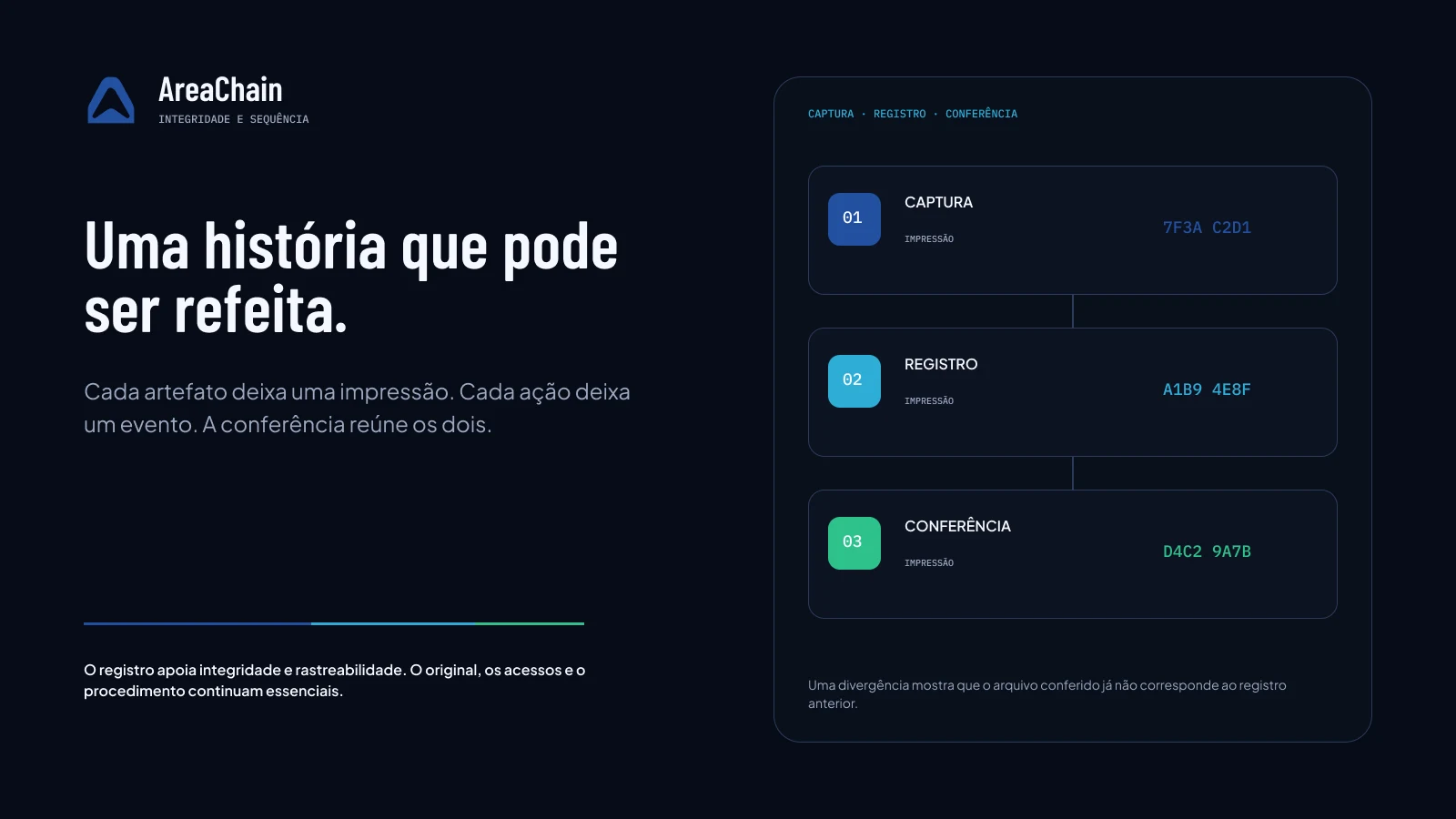
In AreaChain, transactions are not recorded in isolation. They are grouped into data blocks at regular time intervals. Each generated block receives its own hash signature, calculated from two variables: the set of transactions contained in that specific block and the hash signature of the immediately preceding block.

This mathematical binding creates a chain of dependent blocks. If a fraudster tries to alter a record inserted in a block generated two years ago, the hash of that old block will be changed. Since the following block used that old hash to calculate its own signature, the hash of the second block also becomes invalid. This domino effect propagates instantly up to the most recent block in the network, breaking the integrity of the entire blockchain and alerting the validator nodes to the violation.

  +-------------------------------------------------------------------------+
  |                          BLOCK CHAINING                                |
  |                                                                         |
  |  [ Block N-1 ]             [ Block N ]                 [ Block N+1 ]    |
  |  - Data                    - Data                      - Data           |
  |  - Previous Hash           - Previous Hash (N-1) ----> - Previous Hash  |
  |  - Own Hash -------------> - Own Hash                  - Own Hash       |
  |                                                                         |
  |  * If the data in Block N-1 is altered, its Own Hash changes,           |
  |    invalidating the reference held in Block N and breaking the chain.   |
  +-------------------------------------------------------------------------+

3. Merkle Tree Structure (Merkle Trees)

To ensure that integrity verification is fast and consumes few computational resources, AreaChain organizes the transactions within each block using Merkle Trees. This structure arranges the hashes of individual transactions into pairs, calculating the hash of the combination of these pairs successively until only a single hash remains at the top of the pyramid, known as the Merkle Root.

The Merkle Root condenses the signature of thousands of transactions into a single 256-bit code recorded in the block header. This method allows a digital forensic expert to confirm the presence and integrity of a specific transaction within the block without needing to download or process all of the other thousands of records contained in the network, optimizing the external auditing process.

4. Cryptographic Timestamps

Each transaction inserted into AreaChain receives a precise timestamp, integrated into the calculation of the block's hash. This timestamp does not depend on the local clock of the server where the data was generated, which could be easily altered by the system administrator. The timestamp is synchronized with official atomic time sources and distributed among the network's validator nodes, creating an irrefutable temporal proof that the information existed exactly in that form at that moment in time.

The Permissioned Consensus Mechanism

In public blockchain networks, consensus among nodes relies on competitive and expensive algorithms, such as Proof of Work. In AreaChain, consensus is achieved through high-efficiency permissioned consensus protocols, such as Raft or variations of the Practical Byzantine Fault Tolerance (PBFT) algorithm.

In this model, the validator nodes operated by the different entities participating in the network communicate directly to approve the entry of new blocks. Consensus requires that the absolute majority of nodes validate the signature and chronological order of the transactions before the block is definitively recorded on the network.

This mechanism guarantees that, even if Areatec's central server were breached and its data modified locally, the external validator nodes would reject the alteration because they would find no match with the distributed mathematical chain, preserving the truth of the facts.

The development of AreaChain was not merely a software engineering exercise; it was a direct response to the requirements of the Brazilian legal framework regarding electronic evidence. The platform was designed to ensure strict compliance with three pillars of our legislation:

  • Code of Criminal Procedure (Articles 158-A to 158-F): Law No. 13,964 of 2019 regulated the chain of custody of evidence in Brazil. AreaChain acts as the definitive repository for preserving digital evidence, guaranteeing that the record has not undergone any alteration from the moment of its capture in the real world until its presentation in court.
  • Brazilian Internet Civil Framework (Law No. 12,965 of 2014): The legislation requires the secure and confidential safekeeping of application access logs. AreaChain shields these access logs, preventing system administrators from erasing traces of improper access or data modifications.
  • General Data Protection Law - LGPD (Law No. 13,709 of 2018): To reconcile the immutability of the blockchain with the "right to be forgotten" and the privacy of citizens, AreaChain adopts a Privacy by Design architecture. Sensitive personal data is not recorded directly on the blockchain. Instead, the system generates the cryptographic hash of the local record containing the information and writes only that hash to the network. Privacy is preserved and the integrity of the original file can be verified at any time by comparing its hash with the immutable record on the blockchain.

Independent Forensic Auditing

The great innovation of AreaChain is the democratization of forensic analysis. In the traditional storage model based on SQL relational databases, validating a record requires hiring a specialized audit that needs to access the company's servers, analyze the internal logs, and trust the statements of the system administrators.

With AreaChain, any judicial expert or independent technical assistant can perform the verification autonomously. Areatec provides a public validation tool. The expert only needs to load the original digital file (such as an infraction image or a traffic report) into the tool.

The system calculates the SHA-256 hash of the file locally and queries the public AreaChain network. If the generated hash is identical to the hash recorded on the blockchain on the indicated date, the integrity and authenticity of the document are mathematically proven, without the expert needing to access Areatec's internal servers or trust our word.

The table below summarizes the practical differences between the traditional database model and the immutable AreaChain architecture:

Comparison Criterion Traditional Database (SQL) AreaChain Architecture
Immutability Guarantee Based on access policies and human trust Mathematically guaranteed by SHA-256 cryptography
Risk of Internal Alteration Possible by administrators with maximum privileges Impossible, as it requires altering the entire hash chain
Auditing Method Complex, requires direct access to servers and logs Simple, performable by any expert externally
Resistance to Attacks Vulnerable to intrusions through credential hijacking Highly resilient due to the distribution of consensus

AreaChain in Practice: Operational Applications

AreaChain is not a theoretical project or an academic white paper. It operates in production, processing the records generated by the largest OCR fleet in the world. Every infraction image captured, every license plate read, every irregular parking record detected passes through AreaChain before being made available to the traffic agency or the judicial system.

Operational applications include the protection of electronic speed enforcement records, the preservation of digital rotating parking evidence, the shielding of urban maintenance reports, and the integrity guarantee of geolocation data generated by Provloc. In all of these scenarios, AreaChain acts as the last line of defense against allegations of manipulation.

When a citizen contests a traffic fine claiming that the image was tampered with, the enforcement agency can request the verification of the hash on the blockchain. If the hash of the original file matches the record stored in AreaChain on the date of the infraction, the proof of integrity is mathematically established. The contestation loses its technical foundation.

Thirty Years of History Projected into the Future

As we complete thirty years of our journey leading technology for intelligent urban mobility, we look back with pride at our trajectory. We watched the market migrate from paper spreadsheets to Clipper systems, and from these to the cloud platforms that manage global fleets of OCR vehicles and process more than fifty million transactions per month.

AreaChain is the consolidation of this history of practical innovation. It represents the closing of a cycle of technological development focused on solving real problems in Brazilian cities. By eliminating the doubt about data integrity, we protect public managers from unfounded contestations, guarantee the legal certainty of citizens, and raise the technical standard of enforcement in Brazil.

"Even though Areatec is a serious company with a reputation built over 30 years, I have always said: it is not enough to say that you are honest and that processes are carried out correctly — we need to PROVE it, preferably mathematically." — Fábio Eduardo Cressoni Batistella, CEO of Areatec

The technology we have developed proves that the integrity of a company is not declared solely in institutional reports; it is demonstrated in the immutable precision of its cryptographic equations. AreaChain is the materialization of this philosophy: trust is not requested, it is proven.